3D movies on display glasses: yes, and the catch is the content
Every major birdbath pair can split a side-by-side frame into true left-and-right-eye 3D — the display part is solved. The catch is 2026: no streaming service ships 3D anymore, so the format lives on discs you own, SBS files, and YouTube oddities.
On this page
3D was supposed to die with the living-room TV. It didn't — it moved to the one display category where it actually works better than flat: glasses-worn screens with a panel per eye. If you're wondering whether your display glasses can do 3D, the answer is yes with an asterisk, and the asterisk is entirely about where 3D content comes from in a year when no streaming service ships it.
The 30-second answer
Yes — if the content is in Side-by-Side (SBS) format. The glasses display one frame containing two half-images; each eye receives its half, and your brain fuses them into depth. XREAL's One series handles SBS and half-SBS natively with its X1 chip; VITURE, Rokid Max, and RayNeo pairs do the same through their viewing apps. The hard part isn't displaying 3D — it's sourcing it: no streaming service offers 3D in 2026, so the library comes from 3D Blu-rays you own, SBS video files, and YouTube's leftover SBS uploads.
Retailer links may earn us a commission; prices verified September–October 2026 — check retailer for current pricing.
2
Halves per SBS frame
one per eye, fused into depth
0
Streaming services with 3D
as of 2026
~960px
Per-eye width, full SBS 1080p
each eye gets half the frame
X1
XREAL's on-board chip
handles SBS + 3DoF natively
01How SBS 3D Works on Birdbath Glasses
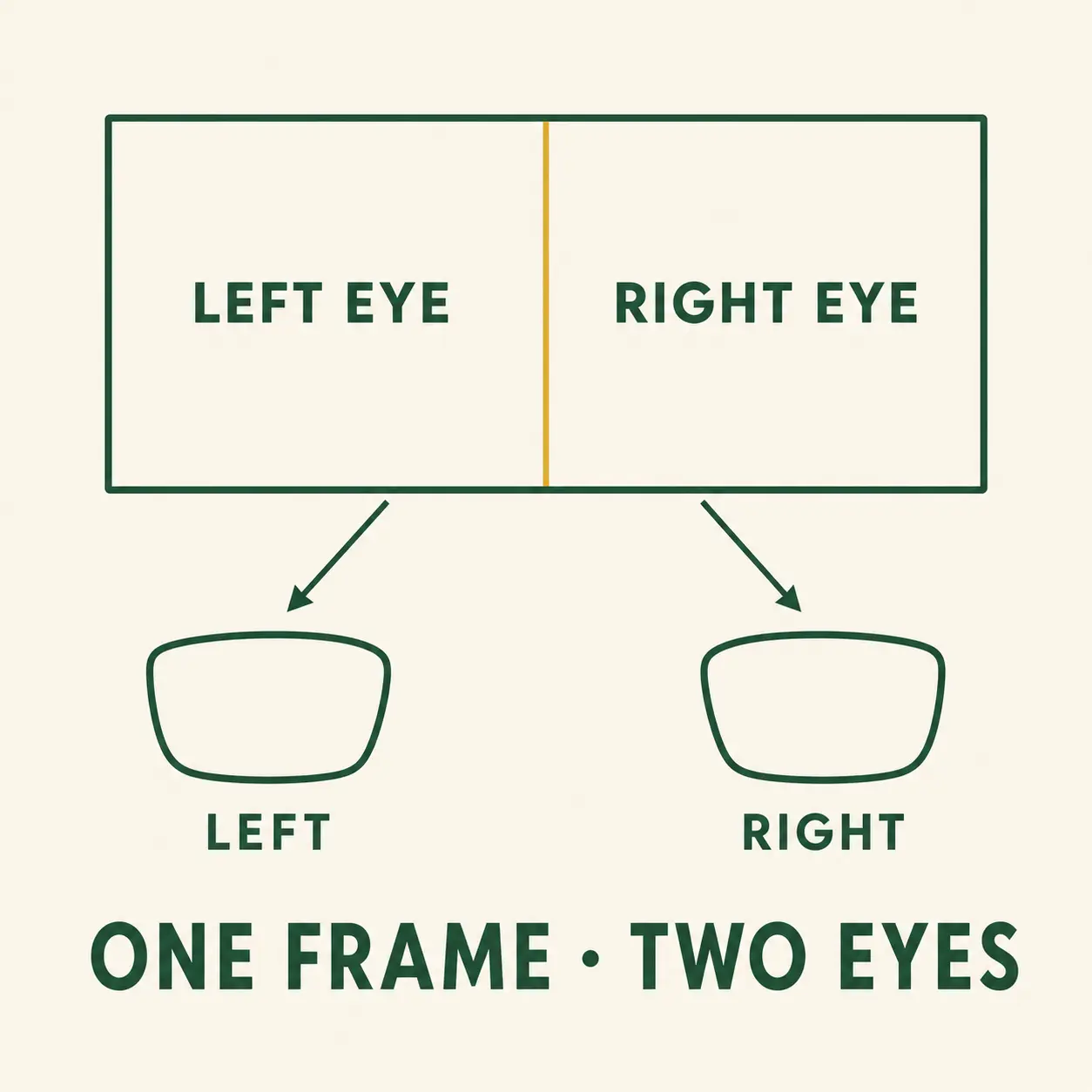
Side-by-side 3D is the least clever and most robust 3D format ever devised. A single video frame is split vertically: the left half contains the scene rendered for your left eye, the right half the same scene for your right eye, with the two views offset by roughly the distance between your pupils. Display that frame on any ordinary screen with the halves separated, and each eye sees only its half — through physical separation in glasses-worn displays, or through shutter/polarization in old living-room setups. Your brain fuses the offset views into depth, exactly as it fuses the real world. OUR ANALYSIS
Birdbath display glasses are almost accidentally ideal for this. Because each eye already has its own micro-display (the architecture our display-technology guide unpacks), SBS playback is just routing: stretch the left half to the left panel, the right half to the right panel, done. No shutters, no polarized filters, no glasses over glasses. Half-SBS (HSBS) squashes each half horizontally to save bandwidth — the same routing, with a sharpness tradeoff. MFR SPEC
02What Each Glasses Family Supports
XREAL's One series — the One, One Pro, and 1S — carries SBS/HSBS support with the X1 spatial chip on board, per XREAL's own documentation and community-maintained guides; the chip that anchors the virtual screen in 3DoF also drives the split-render pipeline, so 3D works with the screen locked in place rather than wobbling with your head. Older Air-line glasses play SBS through phone-side processing. MFR SPEC
VITURE's Pro 2 and Beast handle SBS through the SpaceWalker app, which adds head-tracking to the split. Rokid's Max line plays SBS through its viewing software. RayNeo's Air pairs follow the same pattern. The consistent rule: any modern birdbath pair with a vendor viewing app can split an SBS signal — the differences are in tracking quality and app polish, not in whether 3D works. OWNER REPORTS
What does not do 3D this way: camera glasses (Ray-Ban Meta have no per-eye displays to split) and monochrome-HUD devices — 3D is a two-panel birdbath feature. If you're shopping specifically for 3D, the display-glasses guide is the right shelf. OUR ANALYSIS
03Where 3D Content Comes From in 2026
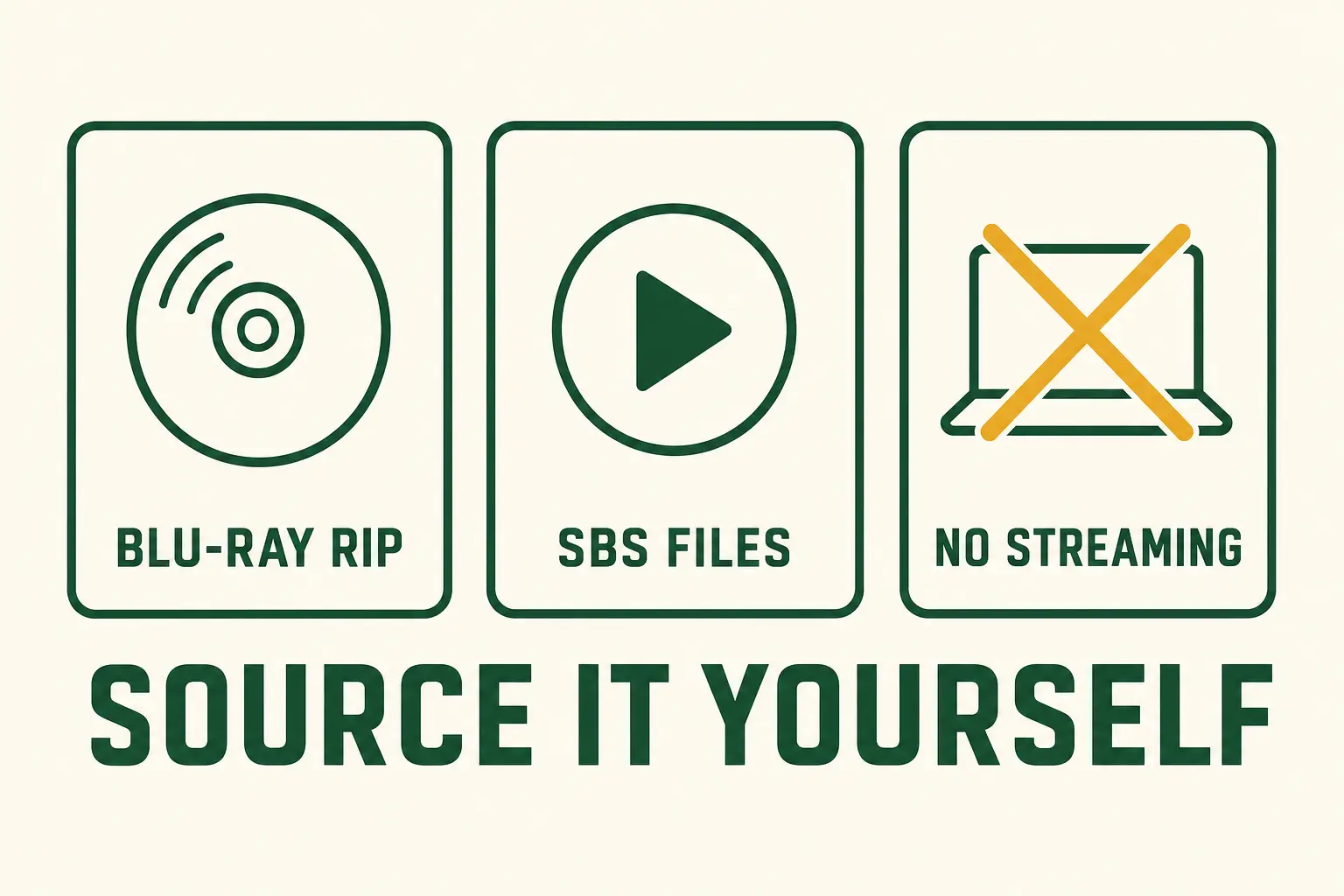
This is the asterisk in the 30-second answer. No major streaming service ships 3D content in 2026 — the 3D catalogs of the 2010s are gone, and the format survives outside them. What remains, honestly inventoried:
3D Blu-rays you own. The deepest library of quality 3D masters ever made sits on discs, many out of print but findable. Playing them on glasses means ripping to SBS files — which works technically and sits in a legal gray zone that varies by country; we frame it as "know your local law," not as instructions. OUR ANALYSIS
SBS video files, purchased or acquired. A small ecosystem sells 3D SBS downloads (nature films, documentaries, demo content), and the format is what it is — an ordinary video file that anything can play. Quality varies from genuine 3D masters to 2D-to-3D conversions of varying honesty. OWNER REPORTS
YouTube's SBS leftovers. Search "3D SBS" on YouTube and you'll find a residual catalog of uploads meant to be viewed in a VR headset or SBS-capable glasses — trailers, demos, amateur 3D. Free, uneven, occasionally wonderful. This is unprotected content, so it outputs to the glasses from nearly any source, phone included. OWNER REPORTS
Our pick
XREAL One
$399approx.
The safe default: sharp 50° display with spatial smarts built into the glasses.
Check price on AmazonRetailer links may earn us a commission — price approx., check retailer.
04The Player Stack, Device by Device
Laptop: the most capable source. VLC and MPV both play SBS with the right output; dedicated stereoscopic players give per-eye alignment controls. The laptop treats the glasses as a plain external display — no certification questions, full format freedom. For DRM-protected purchases the same rules as our streaming guide apply, but SBS files are typically DRM-free. OWNER REPORTS
Android phone or Beam Pro: players with an explicit SBS 3D mode (XPlayer2 and peers in the Play Store) split the halves and send one image per eye through the glasses' native SBS handling. Owner consensus says this path works well on the XREAL One series; the Beam Pro adds battery independence and its own storage. OWNER REPORTS
iPhone: the thinnest support. SBS playback exists through specific apps, but the ecosystem is owner-reported and app-quality varies; the honest recommendation is to test before relying on it, or carry the laptop. OWNER REPORTS
05The Honest Limits
Resolution halves. Full-SBS splits a 1920-wide frame into two 960-wide eye-images; half-SBS gives each eye 960×540. On a virtual screen that reads as soft-but-watchable, not Blu-ray-crisp — the price of the format itself, not of any glasses brand. OUR ANALYSIS
Menus and extras don't survive. Ripped 3D discs play their feature fine, but disc menus, chapter selects, and commentary tracks degrade or vanish in file form — you trade the packaging for the picture. OWNER REPORTS
No 3D streaming means no impulse library. You cannot decide at 9 PM to rent a 3D movie tonight; the library is what you've built. Owners who love 3D treat it as a curated collection, not a catalog. OUR ANALYSIS
the flat-screen home cinema guide → how birdbath displays actually work →
Decoded verdict
The display is solved; the library is the project
Can you watch 3D movies on display glasses? Yes — and better than the living-room 3D that died, because there's no dimming shutter or polarized filter between you and the panels. The question to ask yourself before investing is whether you'll build the library: ripping discs you own (knowing your local law), buying SBS files, and harvesting YouTube's leftovers. If that sounds like a hobby, the XREAL One class will reward it. If you wanted a 3D button on Netflix — that doesn't exist, for anyone, on any device.
Provenance: SBS/HSBS support on the XREAL One series is from XREAL's documentation and the community guide ecosystem; VITURE/Rokid/RayNeo behavior is owner-consensus; the streaming-3D absence is a market fact as of October 2026; the resolution math is format arithmetic, labeled as ours.
Our pick #2
VITURE Pro 2
$299approx.
The 2026 budget king: 63 g, diopter dials, 120 Hz — $299.
Check price on AmazonRetailer links may earn us a commission — price approx., check retailer.
Frequently asked questions
Can Netflix or Disney+ stream 3D to my display glasses?
Is SBS 3D lower quality than a normal 1080p movie?
Do I need to rip my own 3D Blu-rays?
Which glasses are best for 3D?
Does 3D cause more eye strain on display glasses?
Our pick #2
VITURE Pro 2
$299approx.
The 2026 budget king: 63 g, diopter dials, 120 Hz — $299.
Check price on AmazonRetailer links may earn us a commission — price approx., check retailer.