Home cinema with smart glasses: the honest guide
A private big screen on the couch with no TV on the wall — the higher-frequency sibling of the travel scenario. Here's when glasses beat a television at home, when they don't, and which pair to buy for the couch.
On this page
01The case for (and against)
Travel is the scenario display glasses were built for — but home is where they get used most. The pitch is simple: the same 76-gram travel screen doubles as a private living-room display. Late-night movie while your partner sleeps, gaming without waking the house, a cinema experience in a studio apartment with no wall for a TV — the glasses deliver all of it without a single piece of furniture changing.

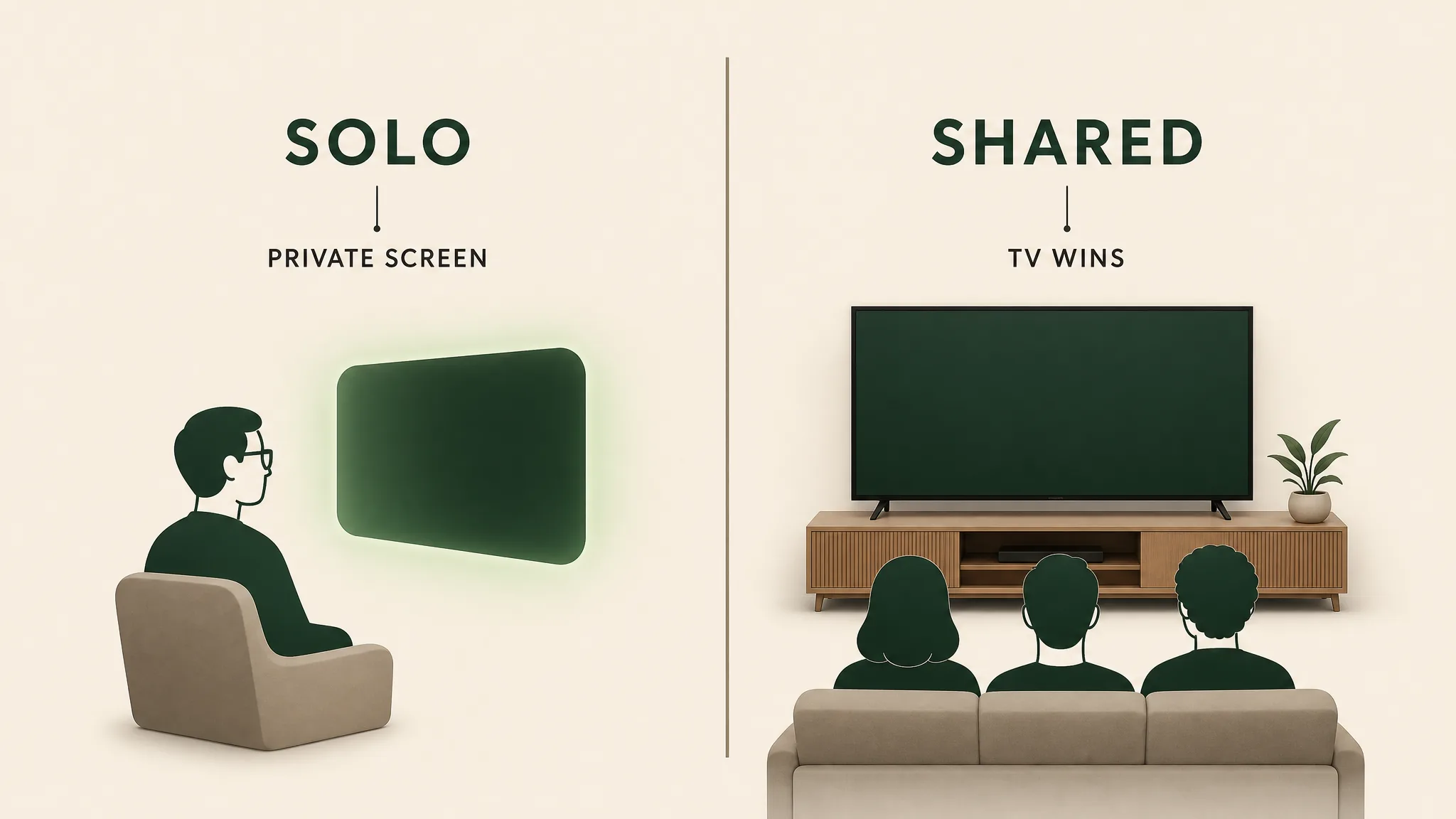
What they are not is a family-room replacement. You see the image; everyone else sees you wearing dark glasses. A tethered display pair is a single-viewer device by design — that is its superpower (privacy) and its ceiling (no sharing) in one spec.
0
wall mounts
the display lives in a drawer
1
viewer per pair
privacy is the feature, not a bug
~2 h
typical movie
comfort window that matters
02The honest limits at home
Three constraints decide whether couch-cinema works for you:
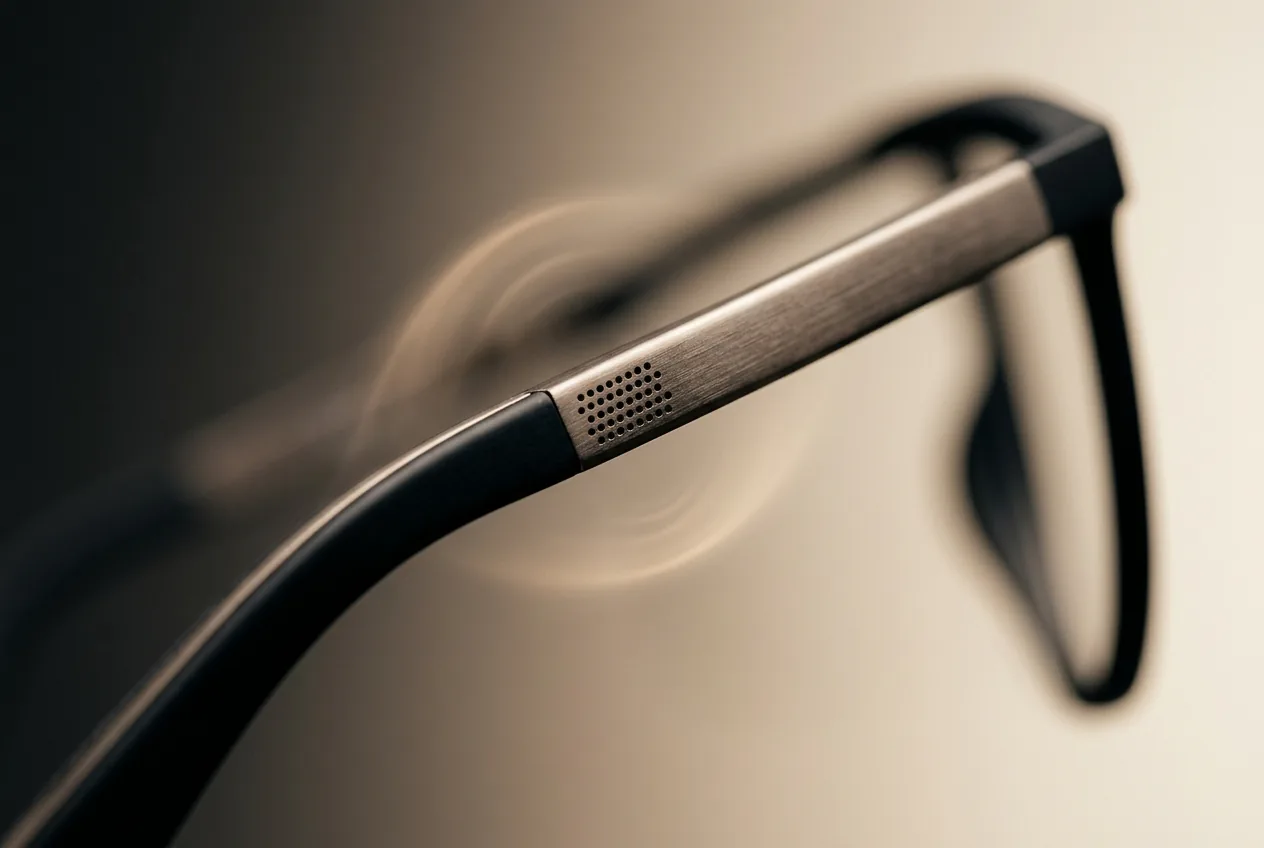
- Sound is open-ear. Tethered display glasses use directional speakers others can faintly hear — great for solo late-night viewing, wrong for shared quiet. Earbuds plug straight in and solve it completely.
- Text is not the use case. Per-eye 1080p at a ~50° field of view delivers cinema-quality video, but dense subtitles and UI text favor a real panel — the productivity guide covers the pixel math (~36–38 PPD vs ~55–60 for a 1440p monitor).
- Two hours is the comfort exam. Weight in the 63–88 g band all passes; anything heavier fails a full movie. If you wear prescription glasses, plan for inserts rather than stacking — the fit-risk guide covers the pre-checks.
Our pick
XREAL One Pro
$599approx.
The widest tethered view in mainstream glasses: 57° FOV in two IPD sizes.
Check price on AmazonRetailer links may earn us a commission — price approx., check retailer.
03What to look for in a home pair
The shopping shortlist for the couch differs from the travel shortlist in exactly two ways: brightness in a lamp-lit room matters more (travel cabins are dark), and battery logistics matter less (the outlet is two meters away). Everything else — per-eye resolution, field of view, weight, 3DoF anchoring for the screen that stays put — is the same spec hunt as the display-glasses rankings.
One home-specific upgrade: if your phone is the source (the simplest couch setup), Samsung owners get the full desktop-style experience via DeX, and a companion unit like the Beam Pro can anchor the screen in space while the phone charges.
Our pick
XREAL One Pro
$599approx.
The widest tethered view in mainstream glasses: 57° FOV in two IPD sizes.
Check price on AmazonRetailer links may earn us a commission — price approx., check retailer.
04The best home pairs
Ranked for couch duty — comfort over a full film first, picture second, price third. Specs from our MFR SPEC-tagged database, verified Aug 2026.
XREAL One
DisplayThe safe default: sharp 50° display with spatial smarts built into the glasses.
$399approx.
List $499, price cut to $399 in Dec 2025
Best for
Key specs
- Weight: 84 g
- Display: 1920 × 1080, 50° FOV
Pairs well with
- → 10Gbps rated USB-C cable — the included one is short; $12–18
- → Powered DP hub — for Switch 2 / handhelds; $60–100
- → Hard-shell case — the panels don't forgive pockets; $15–25
Accessory links may earn us a commission — same price either way. Prices approx.
Retailer links may earn us a commission — see our affiliate disclosure. Price approx., check retailer for current.
VITURE Pro 2
DisplayThe 2026 budget king: 63 g, diopter dials, 120 Hz — $299.
$299approx.
Launched Aug 2026 (5th-anniversary line)
Best for
Key specs
- Weight: 63 g
- Display: 1920 × 1080, 50° FOV
- Diopter dials: 0 to −5.00 D (myopia; no astigmatism correction)
Pairs well with
- → 10Gbps rated USB-C cable — the included one is short; $12–18
- → Powered DP hub — for Switch 2 / handhelds; $60–100
- → Hard-shell case — the panels don't forgive pockets; $15–25
Accessory links may earn us a commission — same price either way. Prices approx.
Retailer links may earn us a commission — see our affiliate disclosure. Price approx., check retailer for current.
VITURE Beast
Display2026's spec-flagship: 58° FOV, 1200p per eye, 1250 nits, electrochromic dimming.
$549approx.
Launched Apr 2026
Best for
Key specs
- Weight: 88 g
- Display: 1920 × 1200, 58° FOV
Pairs well with
- → 10Gbps rated USB-C cable — the included one is short; $12–18
- → Powered DP hub — for Switch 2 / handhelds; $60–100
- → Hard-shell case — the panels don't forgive pockets; $15–25
Accessory links may earn us a commission — same price either way. Prices approx.
Retailer links may earn us a commission — see our affiliate disclosure. Price approx., check retailer for current.
Decoded verdict
Home-cinema verdict
Buy display glasses for home cinema if your viewing is solo, late, or space-constrained — they deliver a genuinely private theater with zero installation and double as the travel screen.
Skip them if movie night means two or more people, or if your evenings revolve around live sports with friends — a TV does something glasses structurally cannot: share.
If you already own a pair for travel or work, you already own the home-cinema setup — plug into whatever is nearest and press play.
Frequently asked questions
Can display glasses replace a TV at home?
Do smart glasses work with Netflix, Disney+ and other streaming apps?
Is a home-cinema pair different from a travel pair?
Our pick #2
VITURE Pro 2
$299approx.
The 2026 budget king: 63 g, diopter dials, 120 Hz — $299.
Check price on AmazonRetailer links may earn us a commission — price approx., check retailer.