Smart glasses with progressive lenses: what actually works
If you wear bifocals or progressives, the good news is counterintuitive: most display glasses put their virtual screen at distance focus, so you may not need your add power to read it at all. Here’s the optics reality, which insert programs offer progressive or bifocal lenses, and the honest limits.
On this page
The question every bifocal and progressive wearer asks before buying display glasses is the one the marketing never answers: will I need my reading add to see the screen? The honest answer is often no — because display glasses place their virtual image at distance focus, not at the near distance your progressives correct. That single optical fact reshapes the whole buying decision, and it’s the reason this guide exists. We’ll walk through the optics reality, which insert programs actually offer progressive or bifocal lenses, and the honest limits of what’s available in 2026.
The 30-second answer
Most presbyopes do not need their add power to read display glasses. Birdbath display glasses form a virtual image at a fixed far point — in the distance-focus zone — so the screen is often readable through your distance or uncorrected vision. Order inserts with your distance prescription, keep your readers for real-world near tasks, and know that progressive or bifocal inserts for display glasses are not confirmed available from any program we could verify this session. If you also have astigmatism, you need inserts with cylinder correction — diopter dials won’t help.
Prescription-lens services require a valid, current prescription from your own eye-care professional. This site does not interpret prescriptions, recommend powers, or advise on eye health.
01The optics reality: where the virtual screen sits
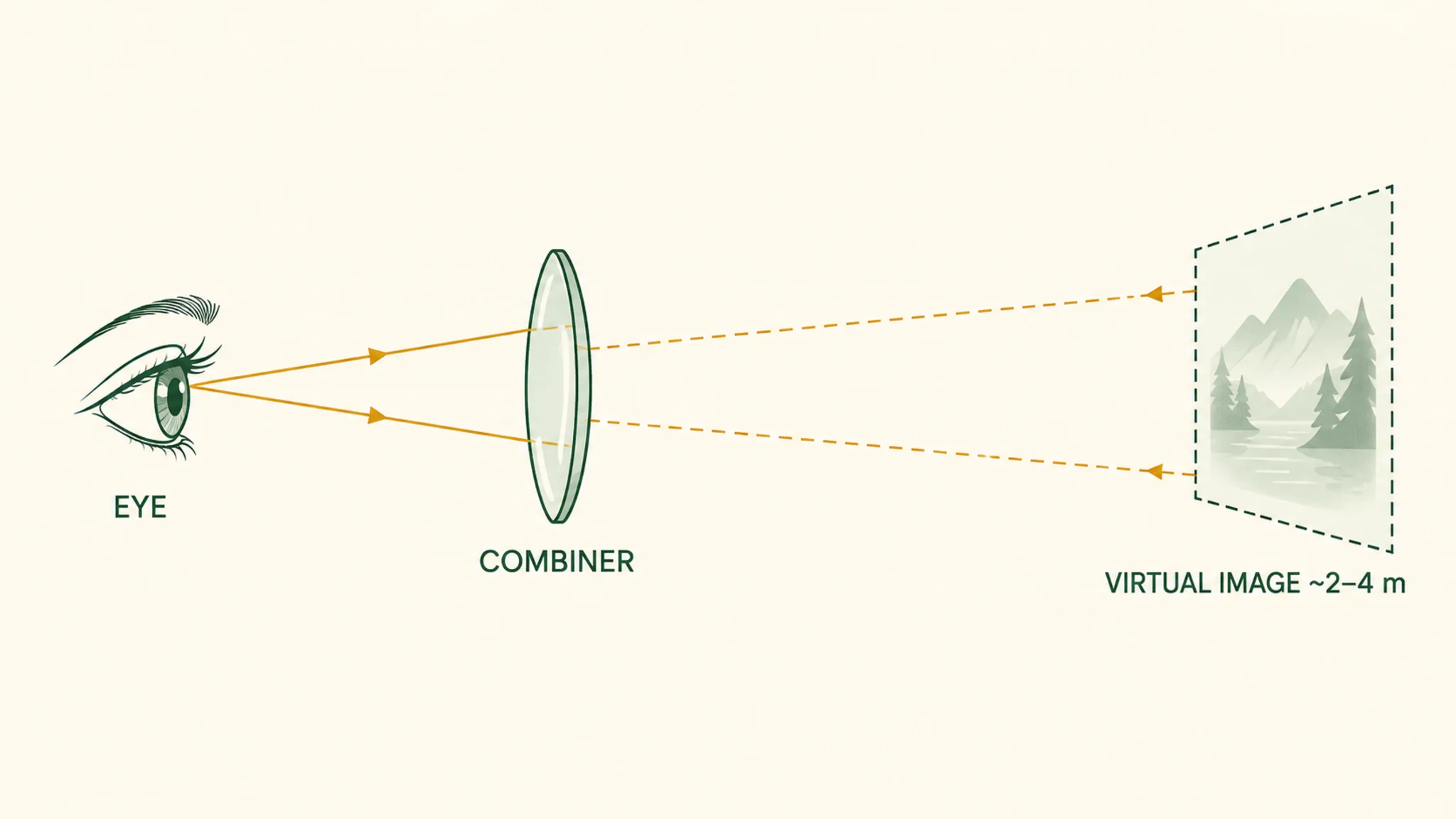
Display glasses like the XREAL One use what the manufacturer calls “Birdbath optics” — a folded optical path that reflects a micro-OLED panel into your field of view. The key consequence is that the image you see is not at the physical panel a centimeter from your eye; it’s a virtual image formed at a fixed far point, in the class of distance most people focus on for a TV or a monitor across a room. MFR SPEC
This is standard display-optics reasoning rather than a number printed on a spec sheet — no manufacturer page we could verify this session states an exact meter figure, so we’re deliberately keeping the number out. What matters for this article is the qualitative mechanism: the display optics — not your eye’s lens — place the image at distance. That’s the fact that changes everything for presbyopes. OUR ANALYSIS
One clarification worth making: the XREAL app’s “screen distance” setting changes the perceived size and distance cues (software scaling and parallax), not the optical focal distance of the display. It’s a tuning control, not a way to move the image into your near-focus zone. OUR ANALYSIS
02Why many presbyopes read display screens fine
Presbyopia is the age-related loss of near accommodation — your eye’s lens can no longer flex to focus on close objects. Reading glasses and the add portion of progressives exist to correct real-world near vision: the phone in your hand, the menu, the keyboard. They correct the distance between your eye and the object. OUR ANALYSIS
Display glasses sidestep that problem entirely. Because the virtual image sits at distance focus, your eye is doing distance work — the thing it still does fine — not near work. The result, and it’s the counterintuitive part:many presbyopes read display-glasses screens comfortably through their distance or uncorrected vision, with no add power at all. The add that makes your progressives work at arm’s length is simply not needed for a screen the optics have already pushed out to distance. OUR ANALYSIS
There’s real-world evidence this is how labs treat display glasses, too. One vendor-published review on VR Rock documents a buyer who ordered VITURE lenses using their reading prescription instead of their distance prescription; support quickly resolved the order toward the distance Rx. It’s a single data point, but it’s consistent with the distance-focused virtual image mechanism above. OWNER REPORTS
03Insert & lens programs: what each offers
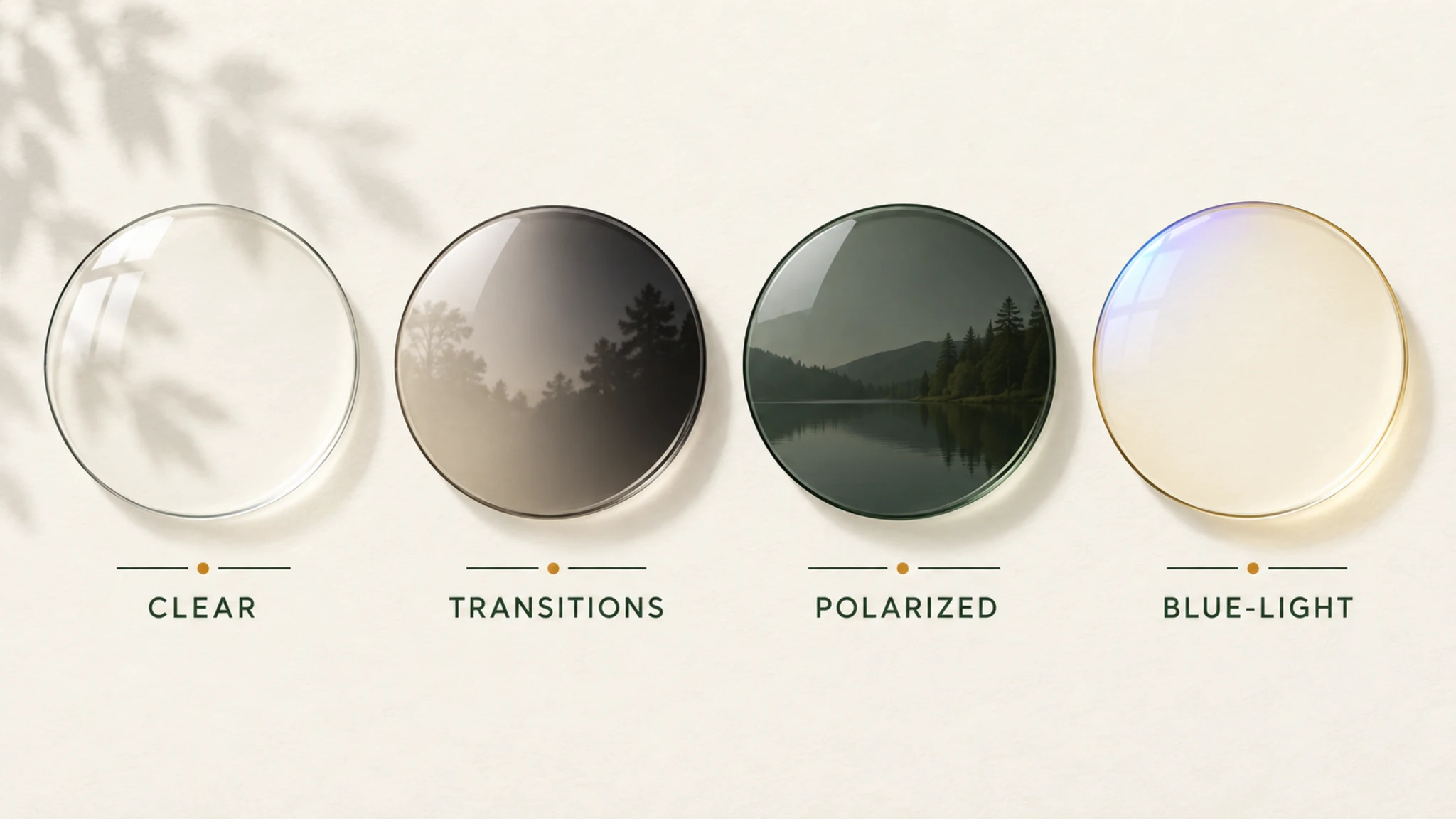
If you do need correction for the display — because you’re also nearsighted, or you have astigmatism, or your distance vision isn’t sharp enough — the question becomes which program can grind your lenses. Here’s what we could verify this session, with each row’s source tier noted. MFR SPEC
| Program / lab | Brands served | Lens types offered | Progressive / bifocal? | Tier |
|---|---|---|---|---|
| XREAL “Complete Prescription Service” | XREAL One/1S, One Pro, ROG XREAL R1, xbx a01+ | 1.60 standard, 1.60 blue-light, 1.67 standard, 1.67 blue-light | Not stated | MFR SPEC |
| HONSVR (third-party lab) | XREAL (officially recommended in XREAL’s FAQ) | “Professional lens service solutions” (details not captured) | Not verified | MFR SPEC (recommendation); lab catalog unverified |
| VR Rock | XREAL, VITURE, Rokid, RayNeo, INMO, Meta AI glasses | Single Vision, Progressive, Bifocal; Transitions (photochromic); Clear; Tinted/Gradient/Polarized; high-index; blue-light; mirror | Yes — but explicit only for Meta camera-glasses pages | MFR SPEC (vendor site) |
| Frames Of Choice | XREAL + other display-glasses brands | Insert lenses −10.00 to +4.00 D sphere, up to ~4.00 D cylinder | Not stated | OWNER REPORTS (site unreachable this session) |
| Lensology | XREAL, RayNeo | Insert lenses, “£79+” pricing noted | Not stated | OWNER REPORTS |
| Even Realities lens service | Even G2 (lenses fitted by Even, not inserts) | Full Rx −12 to +12 D incl. astigmatism; single vision from $159 | Not stated | OWNER REPORTS (range); MFR SPEC (program exists) |
| Halliday first-party Rx | Halliday G2 (Rx lenses at order time) | SPH −9.00 to +2.00 D, CYL −3.00 to +3.00 D, anti-reflective coating, 98% transmittance; free Rx lenses ($199 value) in launch special | Not stated — no ADD value listed | MFR SPEC |
| Rokid | Rokid Glasses (standalone): built-in magnetic optical insert + Prescription Frame accessory; Rokid Max 2: diopter dials; VR Rock sells Rokid Rx lenses | Insert + accessory frame; dial range 0 to −6.00 D | Not stated | MFR SPEC (Rokid Glasses); OWNER REPORTS (dials) |
The pattern is clear: every program that states its lens types leads with single-vision. The one explicit progressive/bifocal listing we found is on VR Rock’s Meta camera-glasses pages — those are real-world eyeglass lenses, not display-glasses inserts. OUR ANALYSIS
Our pick
Even Realities G2
$599approx.
36 g of magnesium and titanium with a quiet green HUD — glasses first, gadget second.
Check priceRetailer links may earn us a commission — price approx., check retailer.
04Reading glasses over glasses & diopter dials
If you don’t need correction for the display itself, the simplest setup is often no insert at all — just your existing readers for the real-world near tasks, and the display glasses for the screen. Many birdbath glasses fit over existing eyeglasses or accept readers underneath, though fit varies by model, so verify before relying on it. OUR ANALYSIS
For nearsighted presbyopes, diopter dials are the other option — and they have a hard limit. The Rokid Max 2 offers 0 to −6.00 D per eye and the VITURE Pro 2 offers 0 to −5.00 D, but both are myopia-only: they run negative and top out at 0.00 D. A presbyope who needs plus power cannot dial it in. So dials help the nearsighted presbyope see the screen, but they don’t touch the near-vision problem your readers solve. OWNER REPORTS Our diopter-adjustment guide covers the full mechanics.
And if you have astigmatism, dials are a dead end — they correct sphere only, not cylinder. Astigmatic presbyopes need inserts ground to their full prescription including cylinder and axis. That’s the single most common reason display glasses look blurry to corrected-vision buyers, and it’s covered in depth in our astigmatism guide. OWNER REPORTS
Our pick
Even Realities G2
$599approx.
36 g of magnesium and titanium with a quiet green HUD — glasses first, gadget second.
Check priceRetailer links may earn us a commission — price approx., check retailer.
05Progressive lenses in inserts: the reality

The honest headline: progressive or bifocal inserts for birdbath display glasses are not confirmed available from any program we could verify this session. Every program that states its lens types leads with single-vision, and the explicit progressive/bifocal listing we found applies to Meta camera-glasses (real-world lenses), not to XREAL, VITURE, or Rokid inserts. OUR ANALYSIS
That’s less of a problem than it sounds, because of the optics reality from earlier: if the virtual screen sits at distance focus, you don’t need a progressive’s add segment for the display at all. The progressive’s value — a smooth ramp from distance to near power — is for real-world vision, which the display glasses don’t affect. So the absence of progressive inserts is a gap in the catalog, not a gap in usability for most presbyopes. OUR ANALYSIS
Where it does matter: if you want a single pair of glasses to handle both the display and real-world near tasks without switching, no current program we verified offers that in an insert. You’re choosing between inserts for the screen and readers for the world, or a progressive pair of real-world glasses worn over or under the display glasses. OUR ANALYSIS
Two range caveats worth knowing. Halliday’s G2 Rx covers SPH −9.00 to +2.00 D and CYL −3.00 to +3.00 D, but lists no ADD value — so high-presbyopia corrections may be out of range; check with Halliday before ordering. And Even Realities’ −12 to +12 D range is the deepest published in the products we track, which makes it the most accommodating for strong prescriptions. MFR SPEC
06Who should do what
Here’s the decision path, by correction type. It’s our reasoning from the optics mechanism and the verified program data, not a medical recommendation. OUR ANALYSIS
- Presbyope with otherwise fine distance vision: skip inserts. The virtual screen sits at distance focus, so you’ll likely read it fine. Keep your readers for real-world near tasks. This is the largest group and the simplest answer.
- Nearsighted presbyope (no astigmatism): diopter dials (Rokid Max 2, VITURE Pro 2) cover the screen if your myopia is within range; otherwise order inserts with your distance prescription.
- Astigmatic presbyope: inserts with cylinder correction are the only path — dials can’t fix cylinder. Order with your distance prescription and confirm the lab handles your cylinder and axis.
- Strong prescription or high presbyopia: Even Realities G2 has the deepest published range (−12 to +12 D); check Halliday’s +2.00 D SPH ceiling before ordering there.
Decoded verdict
The presbyope’s one-line rule
Buy display glasses for the screen, order inserts with your distance prescription if you need any correction at all, and keep your readers for the real world. Don’t chase progressive inserts — they’re not confirmed available for display glasses, and the optics make them unnecessary for most presbyopes anyway.
One expectation-setting note: eye fatigue is the most commonly reported complaint among display-glasses users, and current research shows no evidence of permanent damage. If you feel eye strain, take breaks — and if you have persistent discomfort or a sudden vision change, see a licensed eye-care professional. OWNER REPORTS