Prescription inserts for display glasses: the complete guide
Inserts are the default solution for seeing clearly through display glasses — a frame that clips in behind the optics, with lenses ground to your exact prescription. Here's how they work, what they cost for every major brand, and how to order them right.
On this page
Top insert routes at a glance
If you already know you need inserts and just want the short list: the XREAL One series is the deepest insert ecosystem in the category (official frames plus third-party support); the VITURE Pro 2 is the best route if you're purely nearsighted and prefer diopter dials over custom lenses. The full breakdown is at the bottom of the page — this guide walks through the mechanics, brand-by-brand options, costs, and ordering details first.
Display glasses focus their virtual image at a fixed distance, which means nearsighted and farsighted eyes see a blurry picture until something corrects the mismatch. The industry's default answer is the prescription insert: a thin frame carrying lenses ground to your exact prescription, mounted between the display optics and your eyes. It's a simple, mature solution — and a step a remarkable number of buyers skip, then blame the glasses. This guide covers everything: mechanics, brand-by-brand options, costs, ordering, and the insert-versus-dial decision.

01How inserts work (and why they're needed at all)
Birdbath display glasses place their panels at effectively 1.5–2.5 meters of virtual distance. If your uncorrected vision blurs at that range, the world's sharpest micro-OLED panel still renders soft. An insert sits a centimeter from your eye — inside the glasses' nose compartment or clipped to the frame — holding your corrective lenses exactly where eyeglass lenses would be. The display optics and your correction act independently, which is why inserts correct everything your optician corrects: sphere, cylinder (astigmatism), axis, even prism in some cases.
The insertion mechanics vary by brand — magnetic frames (XREAL One series), clip-ins (VITURE, RayNeo), screw-mount on some older models — but all share the same properties: they add a few grams, they slightly reduce maximum eye relief (how far your eyelashes are from the optics), and they're removable in seconds when a contact-lens-wearing friend wants to try the glasses.
02Inserts by brand: who sells what
| Brand / model | Official option | Third-party path | Notes |
|---|---|---|---|
| XREAL One / One Pro / 1S | Yes — prescription frames, ~$50–60 + lenses | VR Rock, Frame of Choice, Lensology | One Pro needs its size-matched frames (M/L IPD variants) |
| XREAL Air 2 / Air 2 Pro | Yes | Widest third-party coverage of any model | Commonly reported ranges: roughly −10.00 to +4.00 D, ~4 D cylinder OWNER REPORTS |
| VITURE Beast / Pro 2 / Luma | Limited | VR Rock, Lensology, Frame of Choice | Pro 2 covers myopia to −5.00 D via dials first |
| RayNeo Air series / X3 Pro | Limited | Lensology (from ~£79), others | Air 4 Pro supports inserts to −8.00 D |
| Rokid Max 2 | Rx via Rokid partners | Standard insert services | Dials to −6.00 D reduce insert need for myopia |
| Even G2 (HUD) | Yes — Even lenses from $159 | n/a (closed frame) | Deepest range: −12 to +12 D incl. astigmatism |
| Ray-Ban Meta / Oakley (camera) | Rx programs via opticians | Any participating optician | Standard eyeglass lenses, not inserts |
MFR SPEC for official options; third-party coverage is a moving target — search “[model] prescription insert” and buy from services that name your exact model. OUR ANALYSIS
03Ordering without mistakes
Inserts are custom optics — ordering them wrong is the expensive way to learn attention to detail. The checklist:
- Your prescription (sphere, cylinder, axis per eye): get a current one (within 1–2 years). Display glasses work at a fixed virtual distance; your 5-year-old prescription may have been tuned for something else.
- Your PD (pupillary distance): the number prescriptions routinely omit. Ask your optometrist, check your last fitting, or measure it (our IPD guide covers methods). Wrong PD = prism-like discomfort even with a perfect prescription.
- Single vision, near/intermediate-tuned: most services default to distance prescriptions; the glasses' ~2 m virtual distance makes distanceRx the standard choice — mention the use case if your prescription has an add (bifocal/progressive) component.
- Model-exact frames: insert frames are model-specific (an XREAL One frame doesn't fit an Air 2 Pro). Order for the model you own — or will keep.
Our pick
XREAL One
$399approx.
The safe default: sharp 50° display with spatial smarts built into the glasses.
Check price on AmazonRetailer links may earn us a commission — price approx., check retailer.
04Inserts versus diopter dials
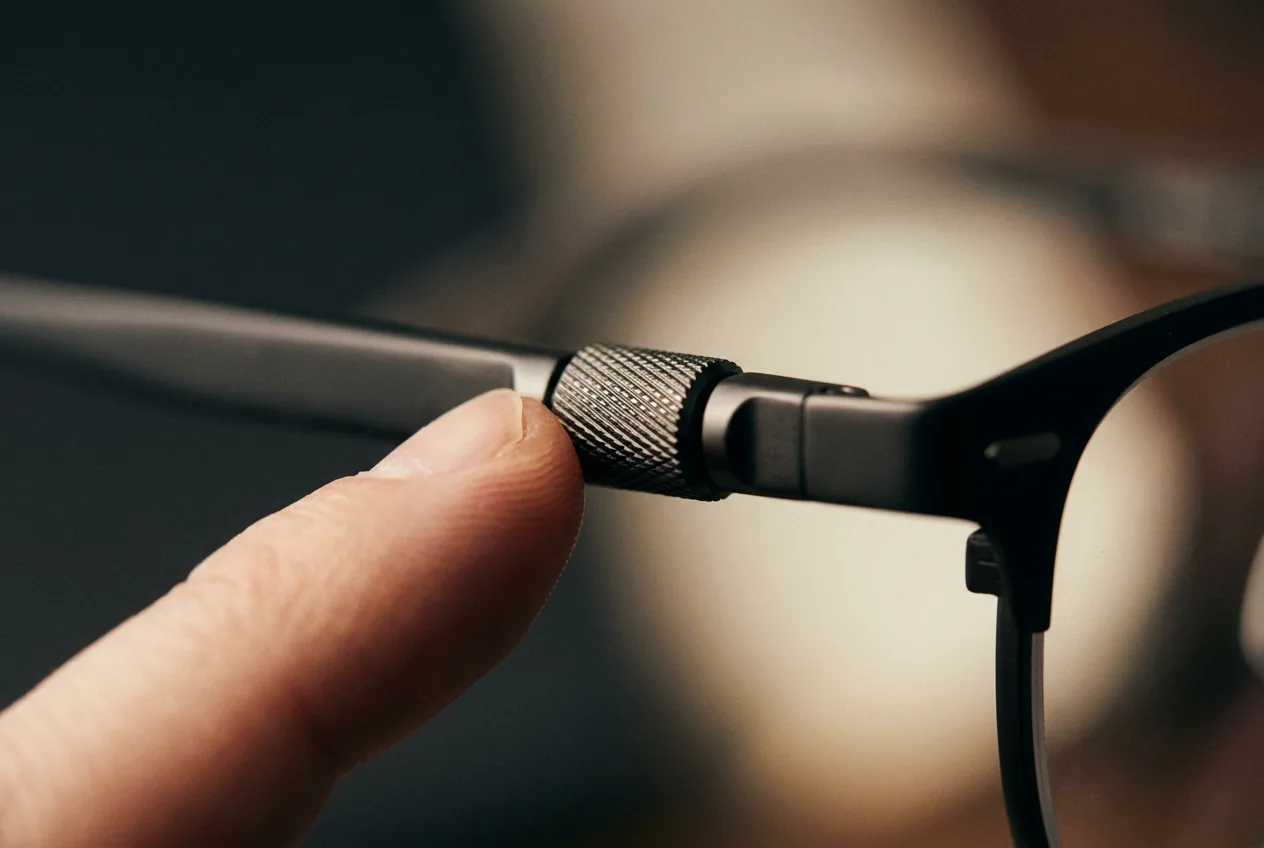
Some models offer physical diopter dials — per-eye focus wheels correcting 0 to −5.00/−6.00 D of nearsightedness (VITURE Pro 2, Rokid Max 2; details in our dial guide). The decision logic is short: dials correct sphere only — if you have any cylinder (astigmatism) or farsightedness, you need inserts or contacts regardless. If you're purely nearsighted within the dial range, dials are genuinely better: instant, shareable with other users, no custom order, no extra cost. Many owners land on a hybrid answer — dials for quick sessions, contacts for long ones — which our glasses-underneath guide discusses.
05The true cost picture
Realistic 2026 budgeting: official XREAL frames ~$50–60 plus lenses brings single-vision totals to roughly $90–130; third-party complete sets run $60–100 (VR Rock, Frame of Choice) to £79+ (Lensology, UK); Even's G2 service starts at $159; high-index lenses for strong prescriptions add $30–60. Against a $399–599 glasses purchase, vision correction is a 15–25% surcharge that converts a blurry toy into a usable device — the single highest-value accessory in the ecosystem, and the one our disclosure page gets the most questions about (yes: insert providers are on our future-affiliate list, because recommending them is unavoidable).

Decoded verdict
Inserts are the answer for most people — order them second, not first
If you wear any corrective lens and you're buying display glasses, insert compatibility is a purchase criterion, not an afterthought: pick from models with mature insert ecosystems (XREAL One series is the benchmark; VITURE and RayNeo both have third-party support), buy the glasses, live with them for a week — dial-assisted if you're purely myopic — then order inserts with a current prescription and a measured PD. Astigmats: skip straight to inserts or contacts; dials cannot help you, and no firmware update ever will.
XREAL One
DisplayThe safe default: sharp 50° display with spatial smarts built into the glasses.
$399approx.
List $499, price cut to $399 in Dec 2025
Pairs well with
- → 10Gbps rated USB-C cable — the included one is short; $12–18
- → Powered DP hub — for Switch 2 / handhelds; $60–100
- → Hard-shell case — the panels don't forgive pockets; $15–25
Accessory links may earn us a commission — same price either way. Prices approx.
Retailer links may earn us a commission — see our affiliate disclosure. Price approx., check retailer for current.
VITURE Pro 2
DisplayThe 2026 budget king: 63 g, diopter dials, 120 Hz — $299.
$299approx.
Launched Aug 2026 (5th-anniversary line)
Pairs well with
- → 10Gbps rated USB-C cable — the included one is short; $12–18
- → Powered DP hub — for Switch 2 / handhelds; $60–100
- → Hard-shell case — the panels don't forgive pockets; $15–25
Accessory links may earn us a commission — same price either way. Prices approx.
Retailer links may earn us a commission — see our affiliate disclosure. Price approx., check retailer for current.