Diopter adjustment dials: built-in vision correction, honestly explained
Some display glasses let you dial focus per eye — a genuinely great feature for nearsighted users, with one hard limitation the marketing never prints. Which models have dials, how far they go, and who should care.
On this page
A diopter dial is the smart-glasses industry's best under-appreciated feature: a small physical wheel per eye that focuses the display for nearsighted vision — no prescription order, no insert purchase, no contacts. For the right buyer it's worth more than any spec-sheet upgrade, because it makes glasses instantly usable. For the wrong buyer it's a blur generator that looks like a defect. The difference between those two buyers is one optical concept, so let's make it precise.
01How the dials actually work
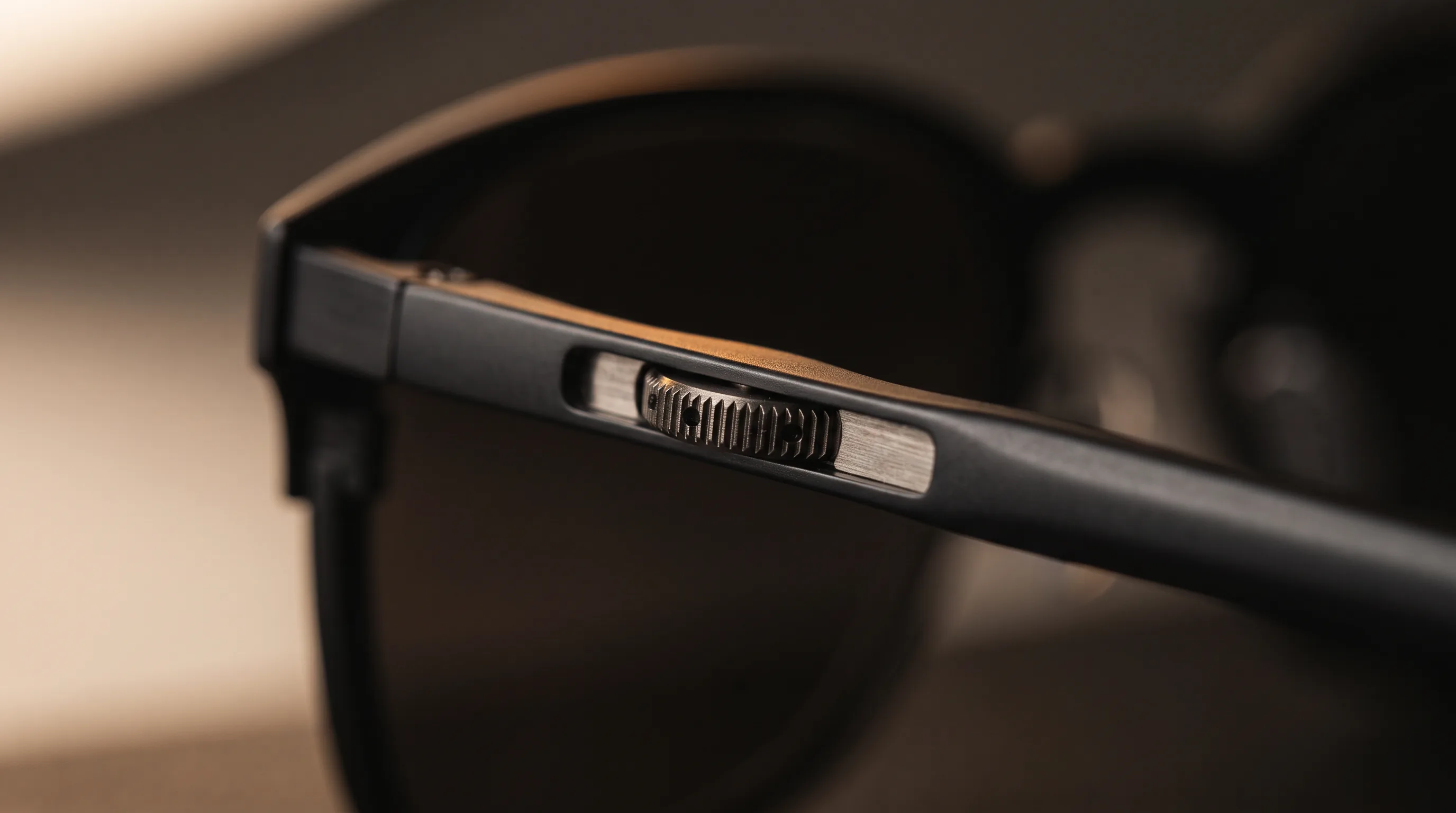
Each eye's optical module gets its own focus wheel (usually on the temple arms or underside of the frame). Turning it slides a lens along the optical axis, adding or removing spherical power measured in diopters — the same unit your prescription uses. A −3.00 D nearsighted eye sets the dial to roughly −3.00 and the virtual image snaps into focus, because the dial shifts the collimated image distance to where that eye focuses. The range labels tell the story: 0.00 D (no correction needed) down to −5.00 or −6.00 D (commonly cited mid-range nearsightedness). MFR SPEC
Practical notes from owner communities: adjust each eye separately in a dark room with high-contrast text on screen; dial past sharp and back to find the center of the focus zone (fine adjustment matters — half a diopter of error is visible as softness); and expect edge sharpness to still depend on IPD fit, which dials don't touch.OWNER REPORTS
02Which models ship dials (Aug 2026)
| Model | Dial range (per eye) | Notes |
|---|---|---|
| VITURE Pro 2 ($299) | 0 to −5.00 D MFR SPEC | The budget king's secret weapon — covers most myopia with no add-on cost |
| Rokid Max 2 (list $429, store sale $279) | 0 to −6.00 D MFR SPEC | Deepest built-in range; Rokid has shipped dials since the original Max |
| Most XREAL models | No dials | Prescription-insert philosophy instead |
| RayNeo Air series | No dials | Inserts (Air 4 Pro commonly reported to −8.00 D sphere OWNER REPORTS) |
| HUD / camera glasses | n/a | Standard Rx lens paths (Even: −12/+12 D MFR SPEC) |
MFR SPEC The strategic split is interesting: XREAL bets on the insert ecosystem (sharper optics, simpler frame), VITURE and Rokid bet on self-service focus. Neither is wrong; they optimize different buyers. If you're nearsighted and prescription-averse, that split alone can pick your brand.
Our pick
Rokid Max 2
$279approx.
Display glasses with −6.00 D diopter dials — strongest built-in vision correction.
Check price on AmazonRetailer links may earn us a commission — price approx., check retailer.
03The limitation that matters more than the range
Dials are spherical-only. They correct myopia — the uniform focal error. They do not correct astigmatism (a cylindrical error along a specific axis), hyperopia (farsightedness — note the ranges go negative only), or presbyopia's intermediate nuances. The consequence in practice: a buyer with −2.00 D sphere and −1.25 D cylinder dials to −2.00, gets partially sharp, and reasonably concludes the glasses are defective. They aren't — the dial is doing 100% of what a spherical lens can do, and the cylinder is untouched. Commonly cited population figures place the share of adults with notable astigmatism at roughly a third, OWNER REPORTS which makes this the single most consequential asterisk in display-glasses buying. Full story in our astigmatism guide.
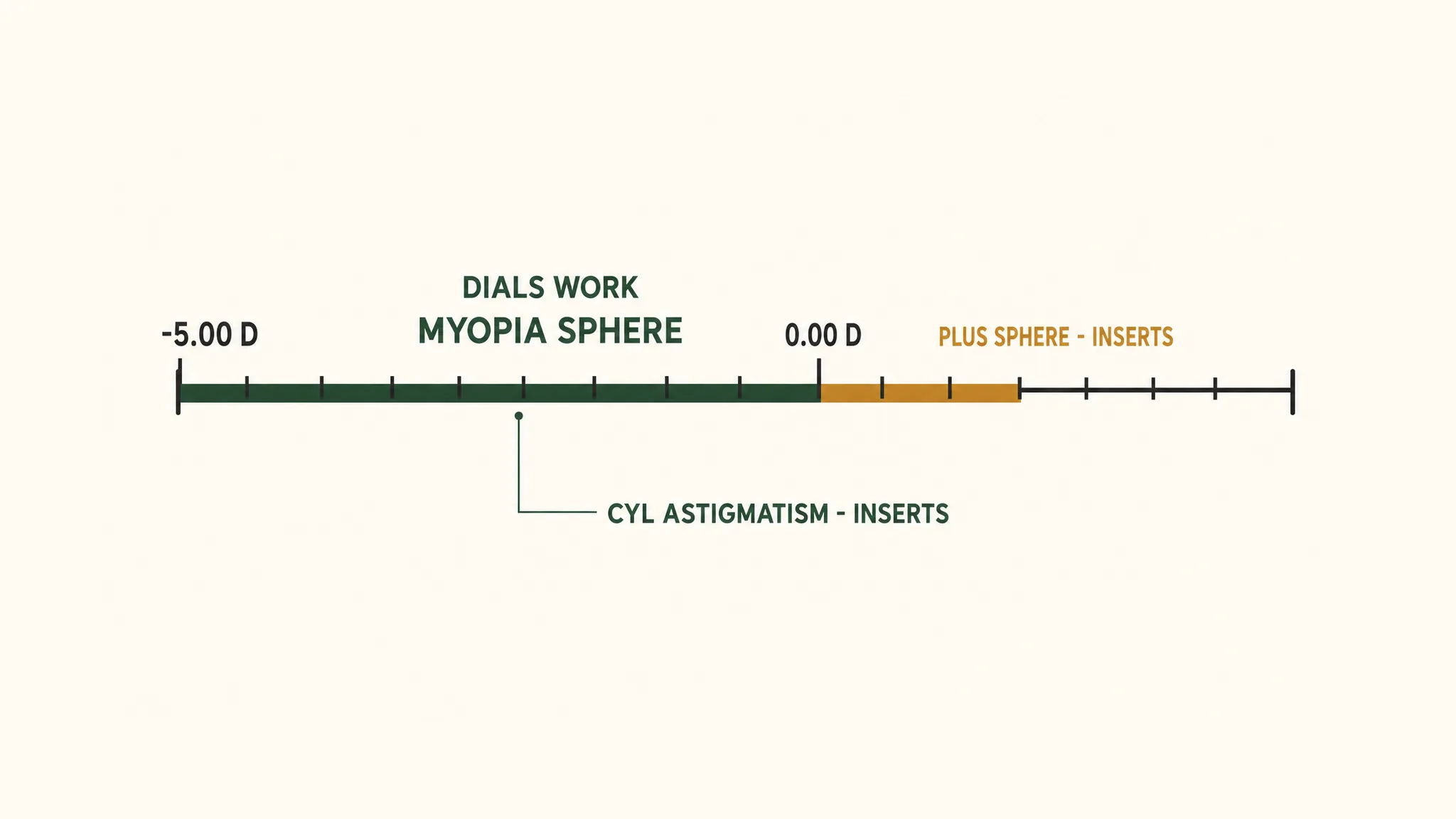
Farsighted buyers (positive sphere prescriptions) have no dial option on any 2026 display glasses — the dial range runs negative only — and will need prescription inserts (lens service ordered with the glasses) or toric contact lenses instead. MFR SPEC
Our pick
Rokid Max 2
$279approx.
Display glasses with −6.00 D diopter dials — strongest built-in vision correction.
Check price on AmazonRetailer links may earn us a commission — price approx., check retailer.
04Dials versus the alternatives, compressed
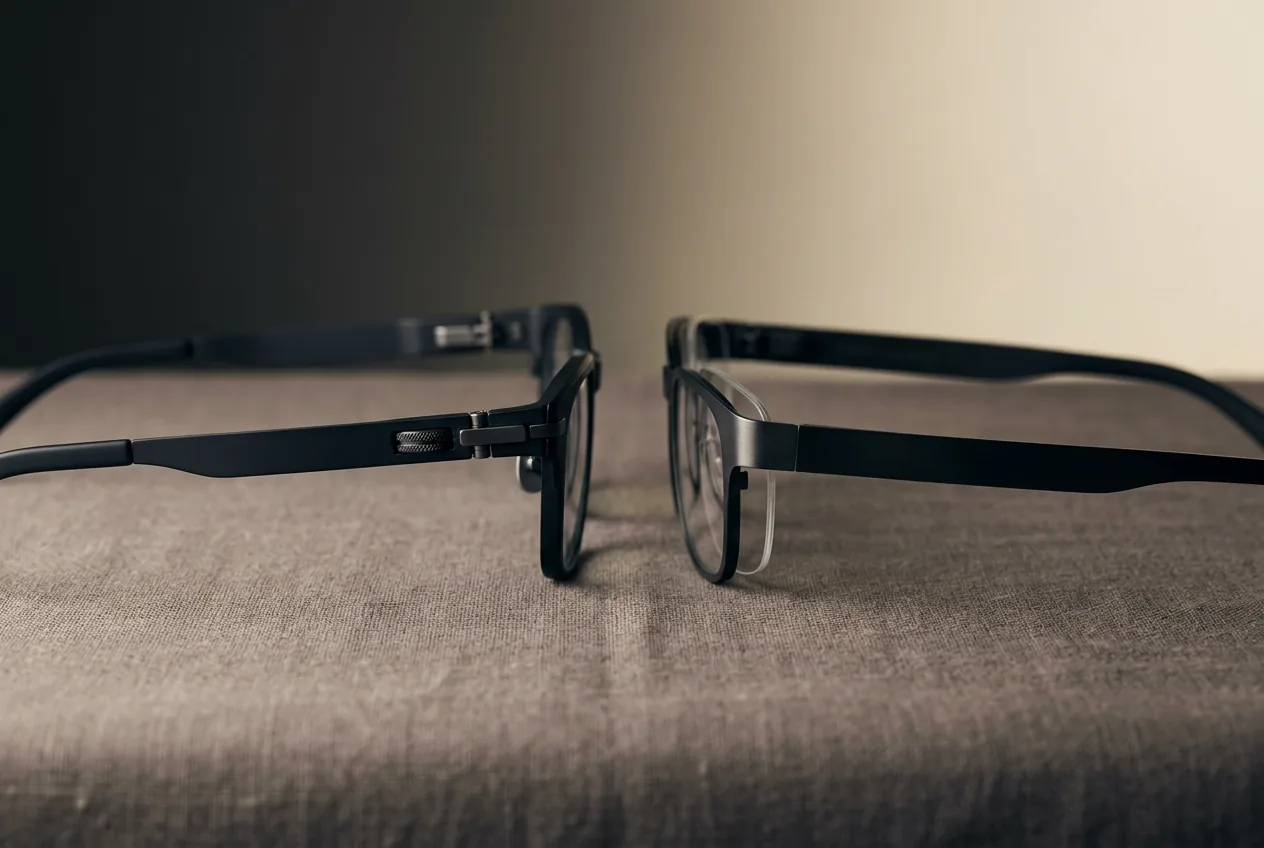
- Dials vs inserts: dials win on cost ($0), immediacy, and shareability — anyone can refocus for their own eyes in seconds. Inserts win on completeness (full Rx incl. cylinder) and on models without dials at all. The VITURE Pro 2 and Rokid Max 2 support both, which is why they're our recurring recommendations for prescription-averse buyers.
- Dials vs contacts: contacts correct everything, invisibly, and make the dial question moot — the strongest solution if you tolerate them. Dials win on mornings-before-coffee convenience and for buyers who can't or won't wear contacts.
- Dials vs glasses underneath: stacking eyeglasses inside display glasses works for zero cost but adds weight, pressure, and fit fragility. Dials are strictly better when your correction fits their range.
Decoded verdict
The dial buyer's one-line rule
Pure myopia within −5.00/−6.00 D: buy dial-equipped glasses (VITURE Pro 2, Rokid Max 2) and enjoy the free ride. Anything cylindrical, farsighted, or stronger: budget for inserts or wear contacts, and treat dials as a bonus for guests — never as your correction.