Astigmatism and smart glasses: the problem spec sheets ignore
Roughly a third of adults have astigmatism, and it's the single most common reason display glasses look blurry to people who 'already corrected' their vision. Diopter dials can't fix it. Here's what can.
On this page
The recurring forum post writes itself: “Bought XREAL/VITURE/RayNeo glasses, dialed in my prescription, still blurry \u2014 is my unit defective?” Nine times out of ten, the unit is fine and the buyer has uncorrected astigmatism. Roughly a third of adults have some cylindrical error; display-glasses marketing mentions diopter ranges and never mentions cylinder once. This page fixes the information gap \u2014 and gives you the actual solutions, because they all work.
01What astigmatism does to a virtual display
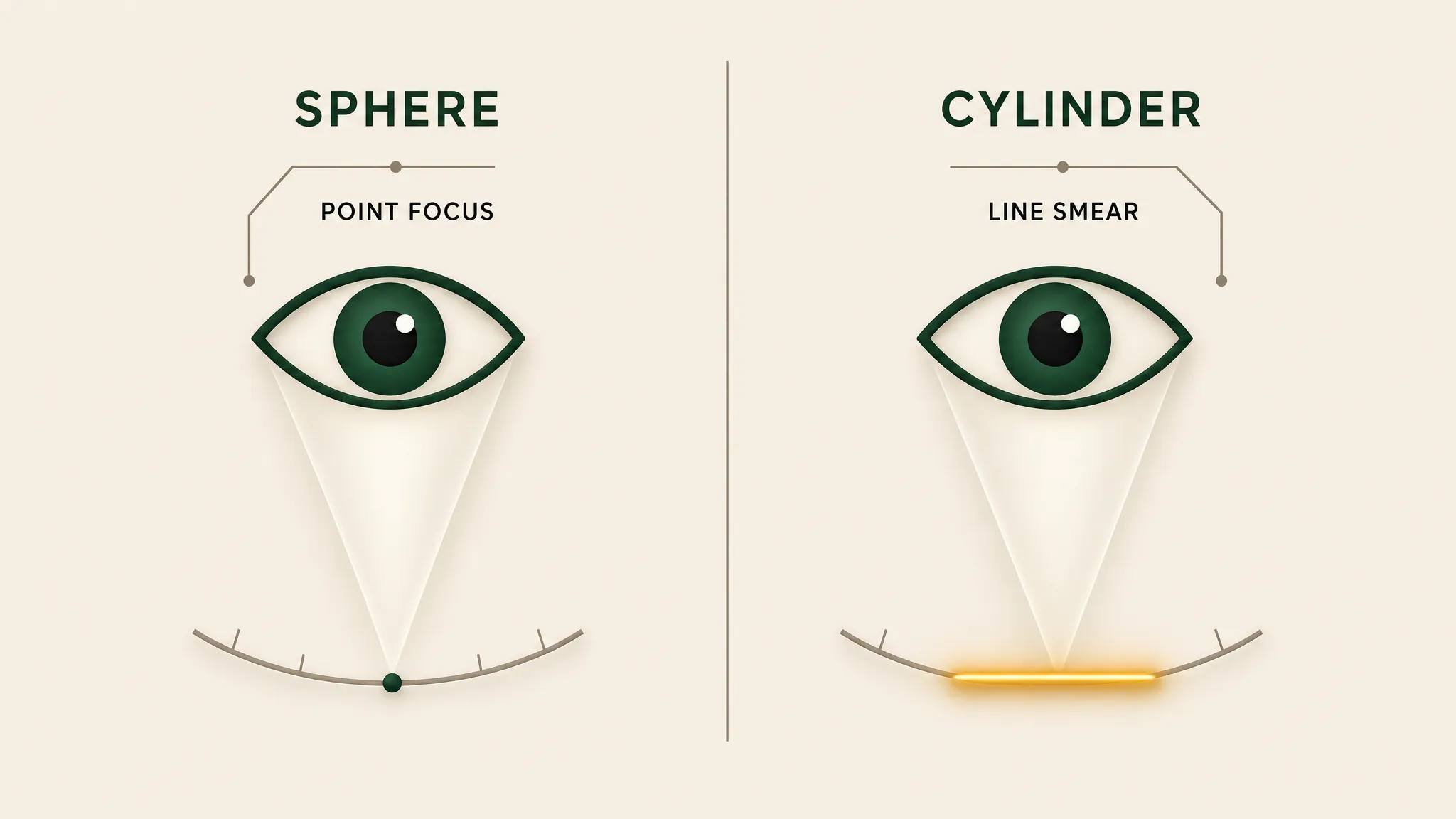
Astigmatism means your cornea (or lens) is shaped more like a rugby ball than a sphere, so light focuses differently along different axes. Point sources smear into lines; contrast drops; text grows halos. On a physical monitor at desk distance, your eyeglasses or contacts correct it before light reaches your eye. On display glasses, the correction must live inside the headset \u2014 and if it's a spherical dial rather than a cylindrical lens, the smearing persists no matter how much you twist.
The tell-tale symptom pattern (from years of owner reports OWNER REPORTS): text that's sharp vertically but ghosted horizontally (or vice versa); sharpness that improves when you squint or tilt your head; one eye fine, the other smeared \u2014 because astigmatism is per-eye and rarely symmetrical. If your optometrist has ever written a number in the cylinder (CYL) and axis columns of your prescription, this page is about you.
02Why diopter dials structurally can't correct it
A diopter dial moves a lens along the optical axis \u2014 pure spherical power. It answers “is the image focusing in front of or behind your retina, uniformly?” Astigmatism asks a second, independent question: “does the image focus the same horizontally as vertically?” A spherical lens can shift the whole focal plane; only a cylindrical lens rotated to your axis can reconcile the two focal planes. That's why the VITURE Pro 2's 0 to \u22125.00 D dials and Rokid's 0 to \u22126.00 D dials specify myopia correction, full stop \u2014 it's not a product shortcoming, it's optics. MFR SPEC
03The three solutions that actually work
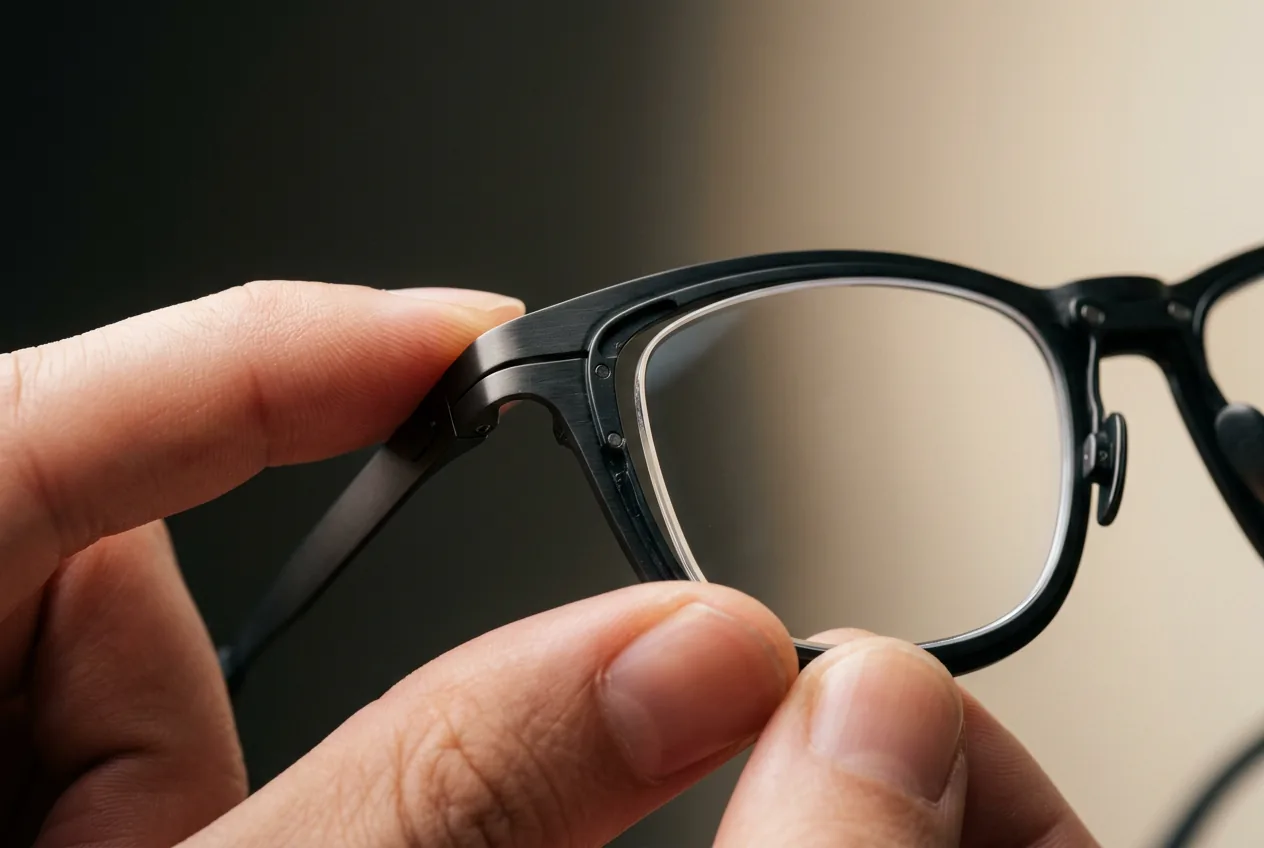
- Prescription inserts \u2014 the default answer. Ground to your full Rx including cylinder and axis, mounted inside the glasses. Works with every display-glasses brand (XREAL official frames; VR Rock, Frame of Choice, Lensology for everything else), costs $60–150, handles up to ~4 D of cylinder in most services. Full mechanics in our inserts guide.
- Contact lenses \u2014 the quiet favorite. Contacts correct astigmatism (toric lenses) at the eye, eliminating the correction-inside-the-headset problem entirely, and they solve any IPD complications the same way. If you already wear contacts, the entire vision layer of display-glasses buying collapses to “buy whatever glasses you like.” The honest reason sites undersell this: there's no affiliate angle in telling you to use what you already have.
- Products with native astigmatism support. Even Realities G2 handles prescriptions from \u221212 to +12 D including astigmatism through its own lens service \u2014 the widest corrected range of any smart glasses MFR SPEC. Ray-Ban Meta and other eyewear-style frames take standard optician-ground Rx lenses. For HUD and camera categories, astigmatism is a solved problem at order time.
Our pick
Even Realities G2
$599approx.
36 g of magnesium and titanium with a quiet green HUD — glasses first, gadget second.
Check priceRetailer links may earn us a commission — price approx., check retailer.
04Product-by-product reality (Aug 2026)
| Product | Astigmatism path | Verdict |
|---|---|---|
| XREAL One / One Pro / 1S | Inserts (official or third-party) | Excellent ecosystem |
| VITURE Beast / Luma | Inserts (third-party) | Fine; dials don't apply |
| VITURE Pro 2 | Dials (sphere only) + inserts for cylinder | Dial + insert combo common |
| RayNeo Air 4 Pro / 3s | Inserts (Lensology et al.) | Supported to ~\u22128 D sphere |
| Rokid Max 2 | Dials (sphere) + inserts for cylinder | Same combo logic |
| Even G2 | Native Rx incl. astigmatism (\u221212/+12 D) | Best native support |
| Ray-Ban Meta / Oakley | Optician Rx lenses | Standard eyewear path |
| Meta Ray-Ban Display | Meta Rx programs (verify at order) | Consult before purchase |
05The buying checklist for astigmats
- Pull your prescription and read the cylinder column. Any number there \u22650.75 D meaningfully affects display sharpness.
- If you tolerate contacts well: problem solved \u2014 toric contacts plus any glasses you like. Stop worrying about inserts.
- Otherwise: shortlist glasses with a named insert ecosystem (XREAL One series is the benchmark; see our display-glasses guide), budget $60–150 on top, and order inserts after confirming you like the glasses.
- Check your IPD against the model's range at the same time \u2014 astigmatism and IPD mismatch produce similar blur, and fixing one while missing the other keeps the headache.
Decoded verdict
Astigmatism disqualifies zero products \u2014 it disqualifies the dial shortcut
Every smart-glasses category has a working path for cylindrical correction. The mistake isn't buying glasses as an astigmat; it's trusting a spherical dial to do a cylindrical job, blaming the hardware, and returning a pair that was one $90 insert away from being perfect. Get your CYL number, pick your path, and the category opens up completely.
The fix path · start here
Prescription inserts are the actual solution for astigmatism — the page above already established that diopter dials correct sphere only and can't touch cylinder. Below are the three insert routes most buyers land on, all brand-agnostic Amazon searches so you can compare current listings and prices yourself. For the deep mechanics (ordering, PD, costs), the full inserts guide covers it.
- 01Official XREAL One frames (~$50–60 + lenses): magnetic prescription frames sold direct for the XREAL One / One Pro / 1S line; the most-established insert ecosystem in the category.Search Amazon
- 02VR Rock prescription inserts: a third-party specialist that lists compatible models for XREAL, VITURE, RayNeo, and Rokid; complete sets commonly reported in the $60–100 range for single vision.Search Amazon
- 03Frame of Choice & Lensology inserts: the other commonly-cited third-party routes — Frame of Choice (US) and Lensology (UK, from £79+); both list compatible display-glasses models and grind to your full Rx including cylinder and axis.Search Amazon
Retailer links may earn us a commission — see our affiliate disclosure. Prices approx., check the retailer for current; ranges above are the commonly reported bands from owner reports. The full inserts guide covers ordering, PD, return-window sequencing, and the dial-versus-insert decision.