Rokid Glasses in 2026: price, specs, and what you actually get
Rokid Glasses are a standalone AI+AR pair — camera, assistant, and a small monochrome green heads-up display in a 49 g frame, with no phone tether. Here’s the full spec sheet, the real price, and the honest limits before you buy.
On this page
The Rokid Glasses (With Display) are a standalone AI+AR pair: a 12 MP camera, a GPT + Gemini assistant, and a small monochrome green heads-up display packed into a 49 g frame that needs no phone tether. They are not a monitor replacement — the display is a 480×400 green HUD for glances, not a full-color screen — and that distinction matters more than any spec on the sheet. Here’s the verified picture as of September 2026.
The 30-second answer
Rokid Glasses are a standalone AI+AR device, not a monitor. They carry their own camera, microphones, speakers, and AI assistant in a 49 g frame, with no phone tether. The honest one-line limit: the display is amonochrome green 480×400 heads-up display — fine for notifications, navigation, and translation, not for reading documents or watching media. They sell for $699 on sale (regular $799) as of September 2026. Buy them if you want an AI assistant with a glanceable HUD; buy a tethered display pair if you want a virtual screen.
Prices verified against global.rokid.com on September 12, 2026; check the retailer for current pricing and availability in your region.

01What they actually are
Rokid sells two very different products under the same brand, and confusing them is the most common mistake. The Rokid Glasses (With Display) are the standalone AI+AR model: a binocular micro-LED waveguide display, a 12 MP camera, and a GPT + Gemini assistant all built into the frame, with no phone tether. The Rokid Max 2 is a separate, tethered display pair — a full-color 1080p USB-C monitor with diopter dials that needs a video source. This article is about the standalone Rokid Glasses. MFR SPEC
Rokid markets the pair as the “World’s Lightest Full Function AI&AR Glasses” and the “1st AI Glasses: GPT + Gemini” — marketing claims, but the weight figure (49 g) and the assistant stack (GPT + Gemini) are confirmed on the official spec sheet. The core idea is a pair of glasses that does what a smart assistant does — answer questions, translate, capture, navigate — with a small display for glanceable information, all without pulling out a phone. MFR SPEC
The important framing for buyers: this is an AI device with a HUD, not adisplay device with AI. The display is secondary to the assistant and camera. If your primary goal is a big virtual screen, you’re shopping the wrong category — see the XREAL One comparison below.
02The full spec sheet
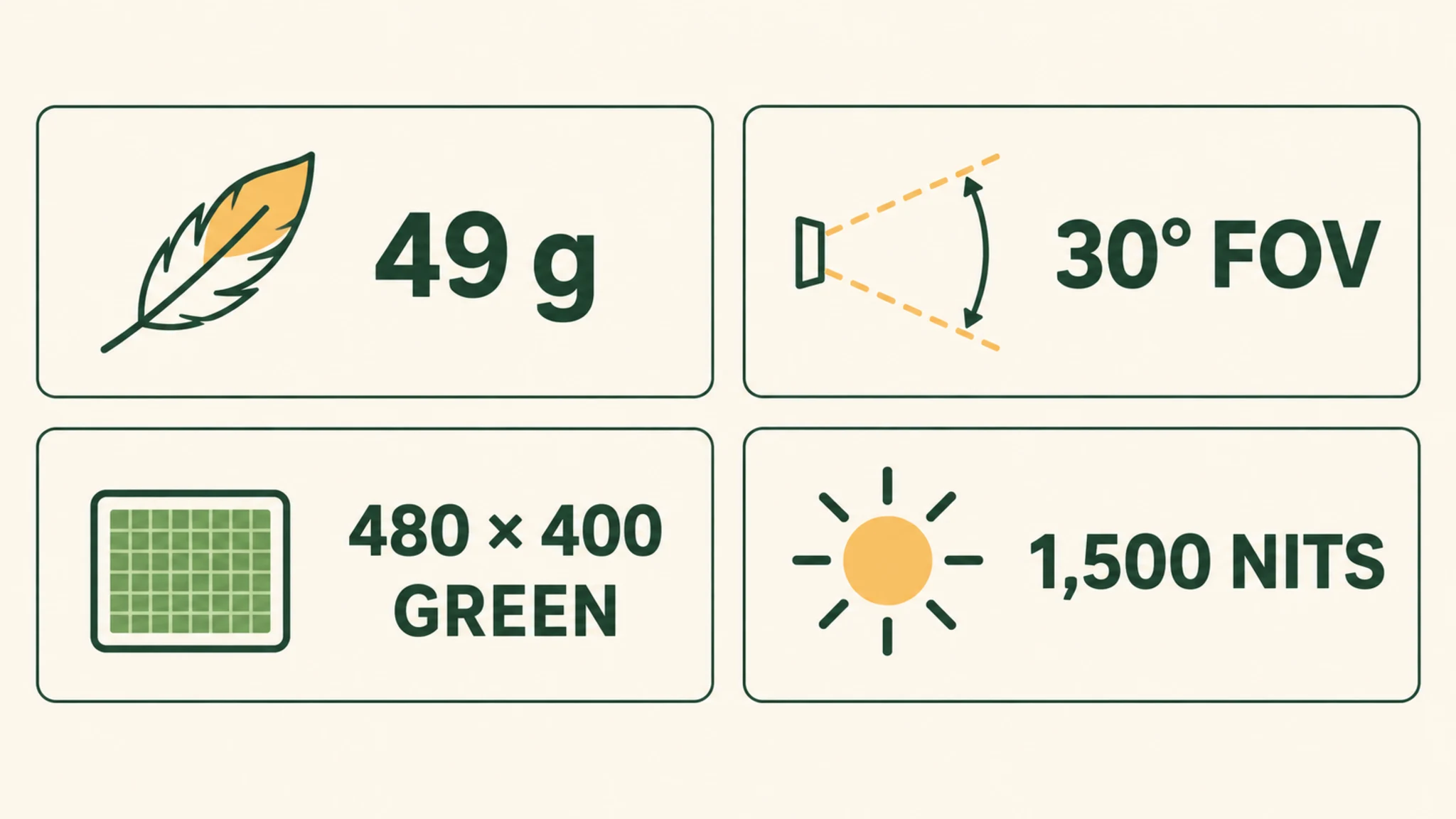
The following figures come directly from the official spec sheet on global.rokid.com, retrieved September 12, 2026. These are manufacturer-published specs, not independent measurements — treat them as the vendor’s claims unless you see independent verification. MFR SPEC
49 g
Weight
Manufacturer spec
480×400
Display resolution
Monochrome green
30°
Field of view
Manufacturer spec
1,500 nits
Brightness
Manufacturer spec
- Weight: 49 g — the lightest “full-function” AI+AR pair Rokid lists.
- Frame: TR90 high-polymer titanium plastic; titanium-alloy hinge.
- Dimensions: temple length 155.5 mm; hinge-to-hinge 146.3 mm; lens width 49 mm; frame height 44.4 mm.
- Display: binocular Micro-LED waveguide (one micro-LED + waveguide per eye).
- Display color: single green — a monochrome green HUD, not full color.
- Field of view: 30°.
- Brightness: 1,500 nits.
- Display resolution: 480 × 400.
- Camera: 12 MP Sony IMX681, F/2.25 aperture, 109° ultra-wide, 1080p 60 fps HDR.
- Photo resolution: 3024 × 4032 (4K 3:4).
- Audio: 4-mic voice pickup; open-ear directional speakers (per marketing copy).
- Chip: “dual-chip performance” built for AI, display, and camera.
- Battery: “all-day long battery” — a marketing claim; no mAh figure on the page.
- AI: GPT + Gemini; “Hi Rokid” wake phrase.
- Prescription: built-in magnetic optical insert; separate Prescription Frame accessory.
- Navigation: full access requires a subscription (per the spec sheet).
Two specs deserve extra attention because they set expectations. First, themonochrome green display: at 480×400 in a single color, this is a heads-up display for text and simple graphics, not a screen for media. Second, thebattery claim — “all-day long” is a marketing phrase with no capacity figure published, so treat real-world battery life as something to verify in owner reports before relying on it for a full day out.MFR SPEC
03Price, SKUs, and accessories
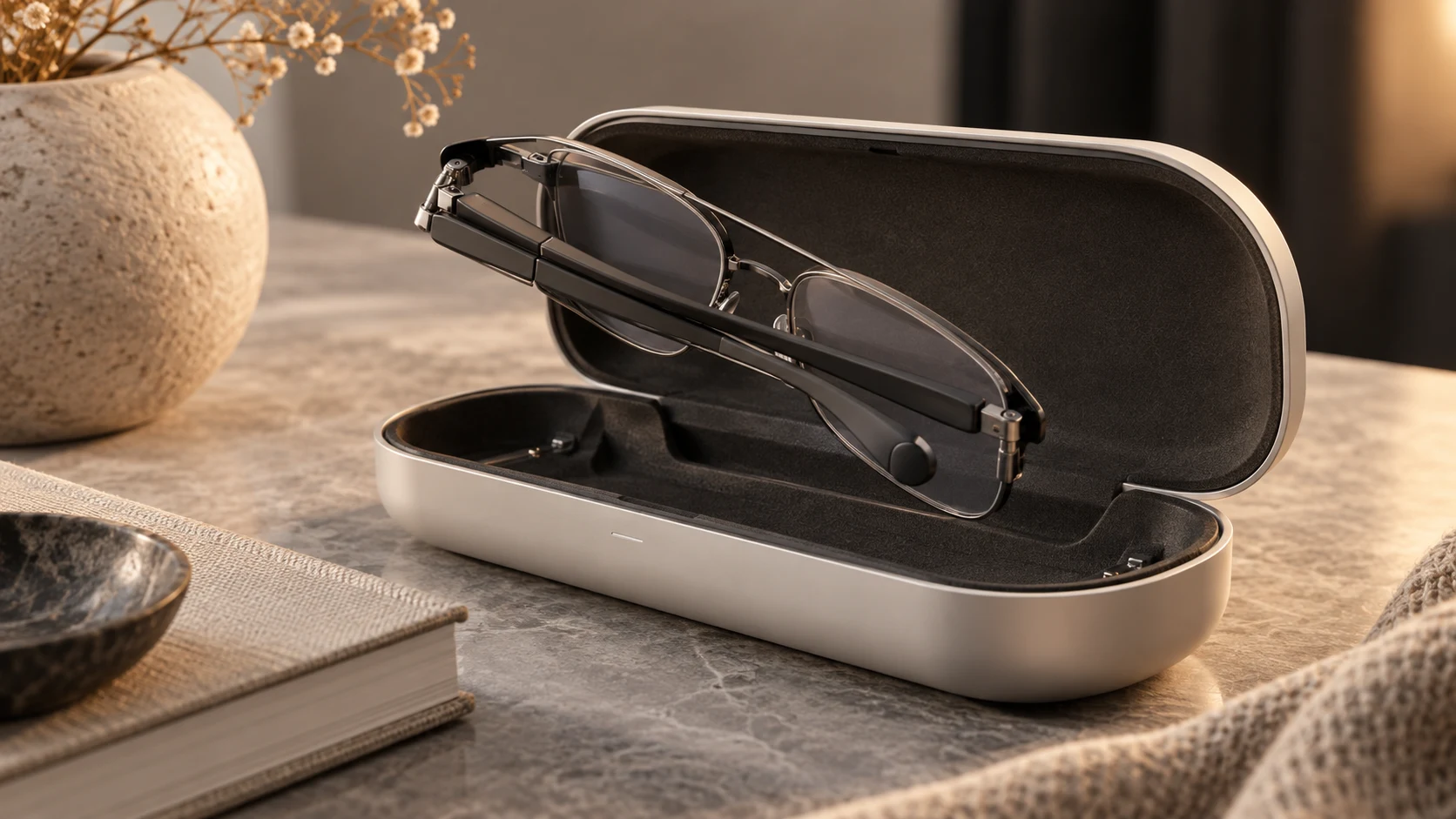
As of September 12, 2026, the Rokid Glasses (With Display) SKU is listed at $699 on sale, with a regular price of $799(13% off) on Rokid’s global store. This matches the assignment brief exactly. Note that the site’s product database previously listed a $599 sale / $699 list — that was inaccurate; the live store shows $699 sale / $799 regular.MFR SPEC
The same storefront lists related SKUs and accessories:
- Rokid Ai Glasses Style (Non-Display) — 25% off (price not captured on our fetch).
- Rokid Ai Glasses Style Pack (Non-Display) — listed.
- Rokid Glasses Charging Case [Display] — $99.00.
- Rokid Glasses Clip On Sunglasses [Display] — $39.00.
- Rokid Glasses Charging Cable — $39.00.
- Rokid Glasses Prescription Frame — listed (price not captured).
Warranty and terms are confirmed on the same page: 30-day returns, a 1-year (365-day) limited warranty, and free standard shipping on US orders over $60. MFR SPEC
The pricing picture is straightforward: $699 is the current sale price, $799 is the ceiling, and the accessories add meaningfully if you need the case ($99) and clip-on shades ($39). A full kit — glasses, case, and shades — lands near $840 before tax. Whether that’s worth it depends entirely on whether you want a standalone AI assistant with a HUD, which is the honest question to ask yourself before buying.
Our pick
Rokid Glasses
$699approx.
49 g standalone AR: full-color waveguides, camera, and assistant — no phone tether.
Check price on AmazonRetailer links may earn us a commission — price approx., check retailer.
04The ecosystem around them
Rokid Glasses don’t exist in a vacuum — they’re part of a broader Rokid lineup, and the companion software matters as much as the hardware.MFR SPEC
The Rokid AI App is the core application for the glasses: it configures the device, manages the media library, and activates AI services. This is confirmed on Rokid’s site. If you’re buying the glasses, plan on using this app for setup and ongoing control. MFR SPEC
Rokid also maintains a separate AR line — the Rokid AR Spatial Set, the Rokid Max 2 AR Glasses, the Rokid AR Joy 2, and the Rokid AR App — which is distinct from the AI Glasses line. The Rokid Station 2 hub (about $239, per our August 2026 notes) is the companion unit that unlocks fuller 3DoF anchoring and multi-screen layouts for the tethered Max 2; it is not required for the standalone Rokid Glasses. OWNER REPORTS
One availability note: Rokid maintains an official Amazon storefront, but we have not verified a specific Rokid Glasses listing or price there this session. If you buy, the safest reference price is the $699 sale / $799 regular on Rokid’s own global store. Regional availability has gaps — verify the glasses ship to your country before committing. OWNER REPORTS
Our pick
Rokid Glasses
$699approx.
49 g standalone AR: full-color waveguides, camera, and assistant — no phone tether.
Check price on AmazonRetailer links may earn us a commission — price approx., check retailer.
05Honest strengths and weaknesses
Based on the confirmed specs and what reviewers and owners report, here’s the balanced picture. These are not our test results — we’re a research and spec publication, not a hands-on review outlet — so treat the qualitative points as reported consensus, not verified fact. REVIEWS
Strengths
- Lightest 'full-function' AI+AR pair at 49 g — genuinely wearable all day
- Camera + display + translation in one standalone device, no phone tether
- Tom's Guide called it 'a real Meta Ray-Ban Display rival' (reported)
- Built-in magnetic optical insert for prescription wearers
Weaknesses
- Monochrome green 480×400 HUD — not a full-color screen or monitor
- Display software is uneven — PhoneArena noted the display is underutilized in software (reported)
- No wired DP-in — it's a standalone AI device, not a tethered display
- Regional availability gaps; verify shipping to your country
The headline strength is the weight and integration: 49 g with a camera, assistant, and display in one frame is a real engineering achievement, and the standalone design means it works without a phone in your pocket. Reviewers have pointed at it as a credible rival to the Ray-Ban Meta Display line — though that’s a reported opinion, not our verdict.REVIEWS
The headline weakness is the display itself. A monochrome green 480×400 HUD is a glanceable information layer, not a screen. Reviewers have also flagged that the display features are still maturing in software — the hardware can do more than the current apps consistently use it for. And because there’s no wired DisplayPort input, you can’t plug it into a laptop or console as a monitor. If you came looking for a virtual screen, this is the wrong product.REVIEWS
06Rokid Glasses vs XREAL One: different categories
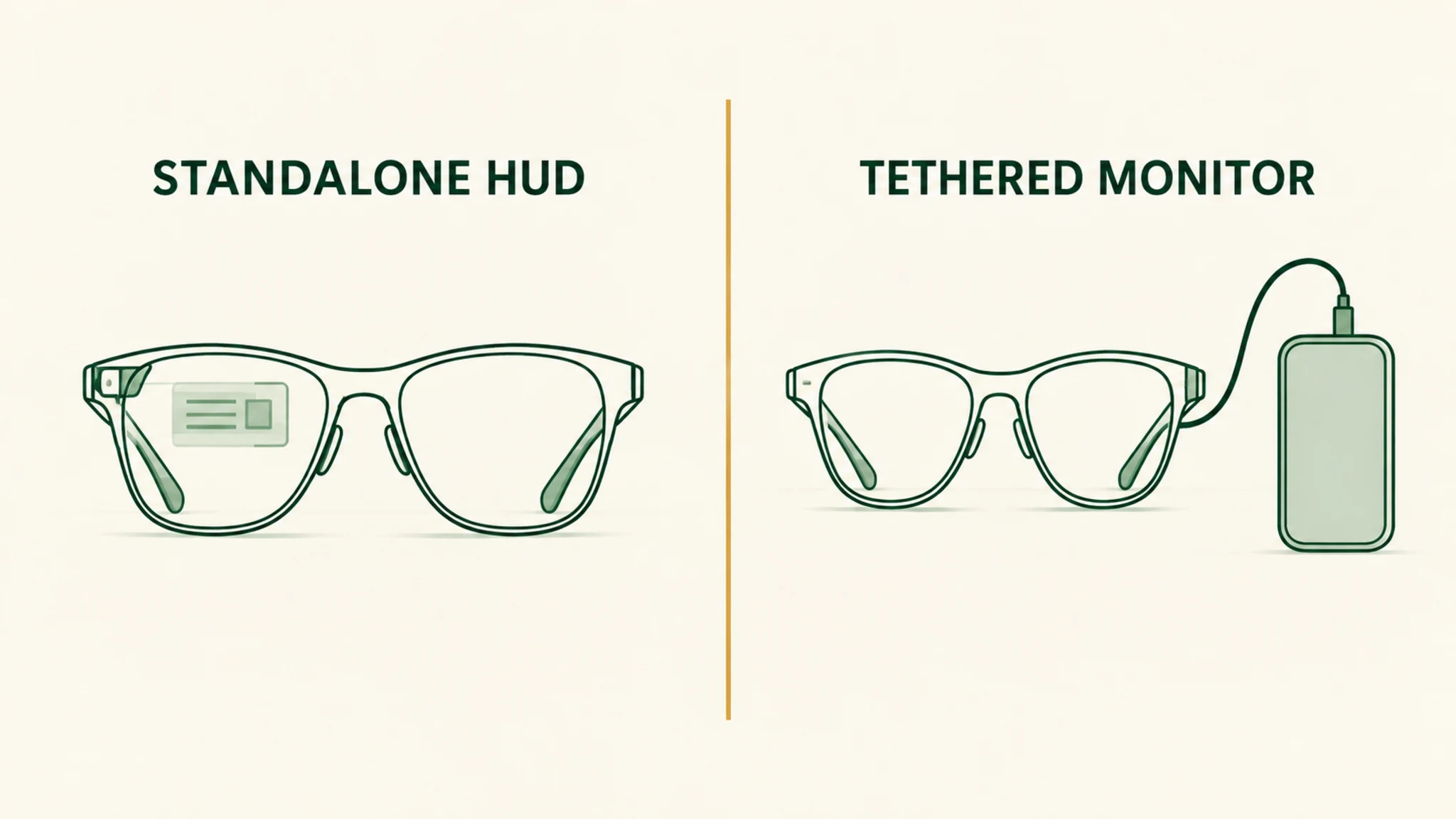
It’s tempting to compare the Rokid Glasses ($699) against the XREAL One ($399) because both are “smart glasses.” But this is an apples-to- oranges comparison, and the honest framing is that they serve different use cases. This is our analysis, not a sourced claim. OUR ANALYSIS
The XREAL One is a tethered display: a full-color 1080p micro-OLED monitor you plug into a phone, laptop, or console over USB-C. It’s for media, gaming, and virtual desktops — a screen you wear. The Rokid Glasses are a standalone AI device: camera, assistant, and a low-res monochrome HUD, no tether. It’s for translation, navigation, notifications, and AI queries — an assistant you wear.
The practical upshot: if you want a private screen for a Steam Deck or a travel monitor, the XREAL One (or another tethered pair) is the category you want, and it’s cheaper. If you want an AI assistant with a glanceable HUD that works without a phone, the Rokid Glasses are the standalone option. They’re not competitors for the same buyer — they’re different tools. OUR ANALYSIS
Rokid Max 2 vs XREAL One — the tethered comparison →Decoded verdict
A capable standalone AI assistant with a HUD — not a monitor
The Rokid Glasses are a well-executed standalone AI+AR device: 49 g, camera, assistant, and a glanceable monochrome green HUD, no phone tether. At $699 on sale (regular $799) with a $99 case and $39 shades, it’s a premium purchase for a specific use case — an AI assistant you wear, with translation and navigation as the standout features.
The honest verdict: buy them if you want a standalone AI assistant with a HUD and you’re comfortable with a monochrome 480×400 display and a still-maturing software layer. Don’t buy them expecting a monitor — that’s the tethered display category, and it’s cheaper. If you’re not sure which you want, start from our best smart glasses guide to see where each category lands.
Our pick #2
Rokid Max 2
$279approx.
Display glasses with −6.00 D diopter dials — strongest built-in vision correction.
Check price on AmazonRetailer links may earn us a commission — price approx., check retailer.
Frequently asked questions
Is the Rokid Glasses display in color?
Do Rokid Glasses work without a phone?
What’s the difference between Rokid Glasses and the Rokid Max 2?
How much do Rokid Glasses cost in 2026?
Can I wear Rokid Glasses with a prescription?
Is the Rokid Glasses display good enough to replace a monitor?
Our pick #2
Rokid Max 2
$279approx.
Display glasses with −6.00 D diopter dials — strongest built-in vision correction.
Check price on AmazonRetailer links may earn us a commission — price approx., check retailer.