Cleaning smart glasses lenses: the no-alcohol rule and the routine that follows from it
The optics on display glasses are more delicate than eyeglass lenses — coatings, combiner layers, and a light path all live millimeters from your fingerprints. The safe routine is short, cheap, and the opposite of what most people do with a shirt tail.
On this page
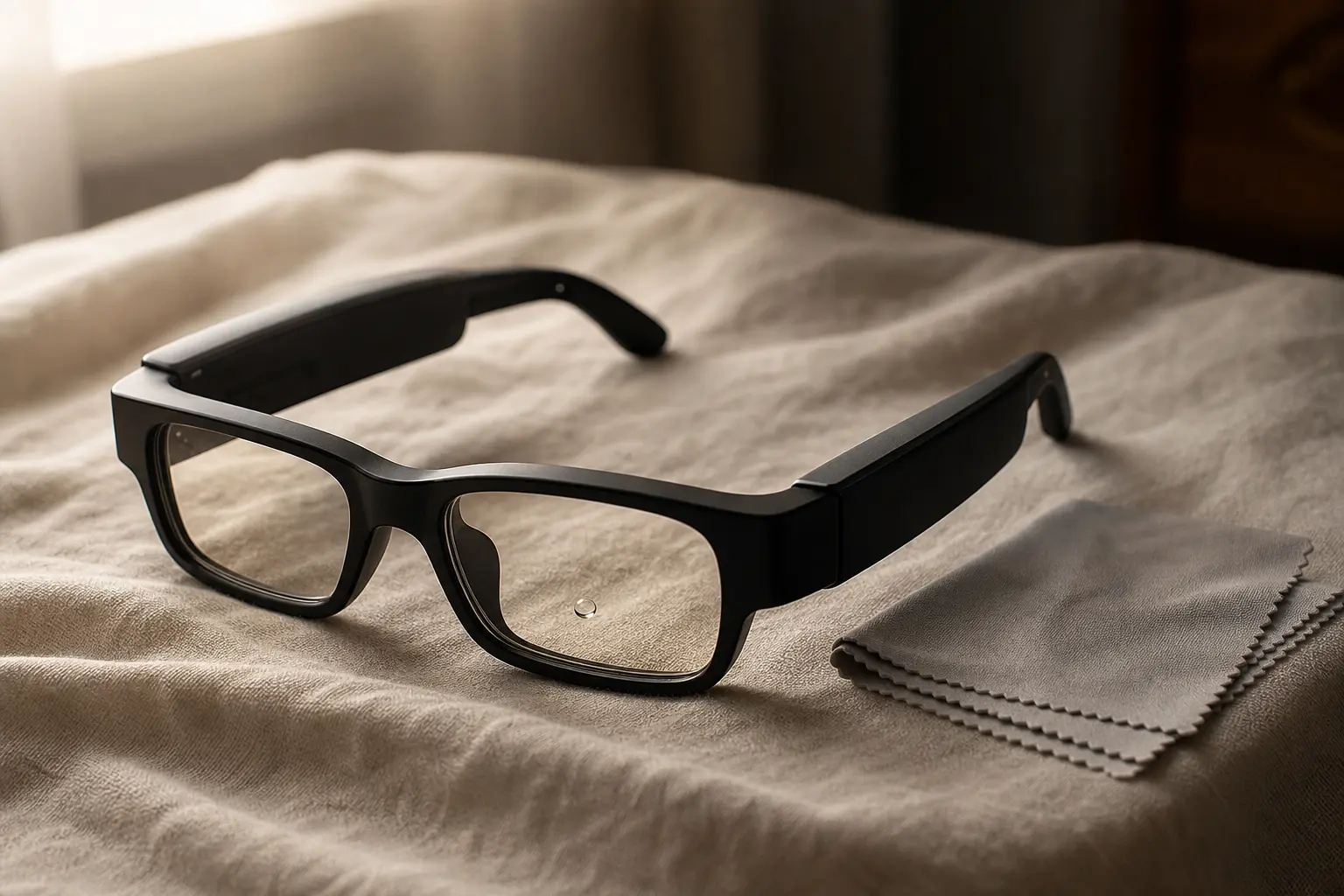
Every smart-glasses owner eventually smudges the one surface that matters most. The fix is not complicated — but it is different from cleaning regular eyeglasses, because the surfaces involved are doing more work: combiner optics, reflective coatings, and on display glasses a micro-OLED light path that ends a few millimeters behind the lens you're wiping. Here is the safe routine, the toolkit that supports it, and the damage catalog it exists to prevent.
The 30-second answer
Microfiber and breath for light smudges; distilled water with a drop of lens soap for grime. Never alcohol wipes, acetone, ammonia window cleaners, or any household cloth that isn't microfiber — solvents degrade optical coatings, and paper fibers and shirt fabric micro-scratch. Blow dust off before anything touches the lens: the routine's entire logic is never drag a particle across glass.
Retailer links may earn us a commission; price ranges are September 2026 approximations — check the retailer for current pricing.
0
Alcohol wipes, ever
coatings degrade, slowly then suddenly
1
Rule above all others
never drag a particle across glass
In-box
Cloth from the maker
XREAL ships one — use it
Distilled
Water over tap
no mineral spots on coatings
01Why These Lenses Are More Delicate Than Eyeglasses
An eyeglass lens does one job: bend light. The front surface of a birdbath display glass does several at once — it passes the image from the micro-OLED panels through the combiner assembly toward your eye, usually carrying anti-reflective and hard coatings applied in thin stacked layers. Those layers are what make the virtual image clean; they are also what solvents and abrasion attack first. The same physics that makes a smudge visible at every brightness level (the light path passes through it twice) makes a scratched coating permanent. OUR ANALYSIS
Manufacturers treat the topic with their packaging: XREAL ships a cleaning cloth in the One's box alongside the nose pads and case — a quiet signal that the intended tool is microfiber and nothing else. The general care guidance across display-glasses brands is consistent: dry cloth for routine care, no solvents, no liquids near ports or seams. MFR SPEC
02The Toolkit
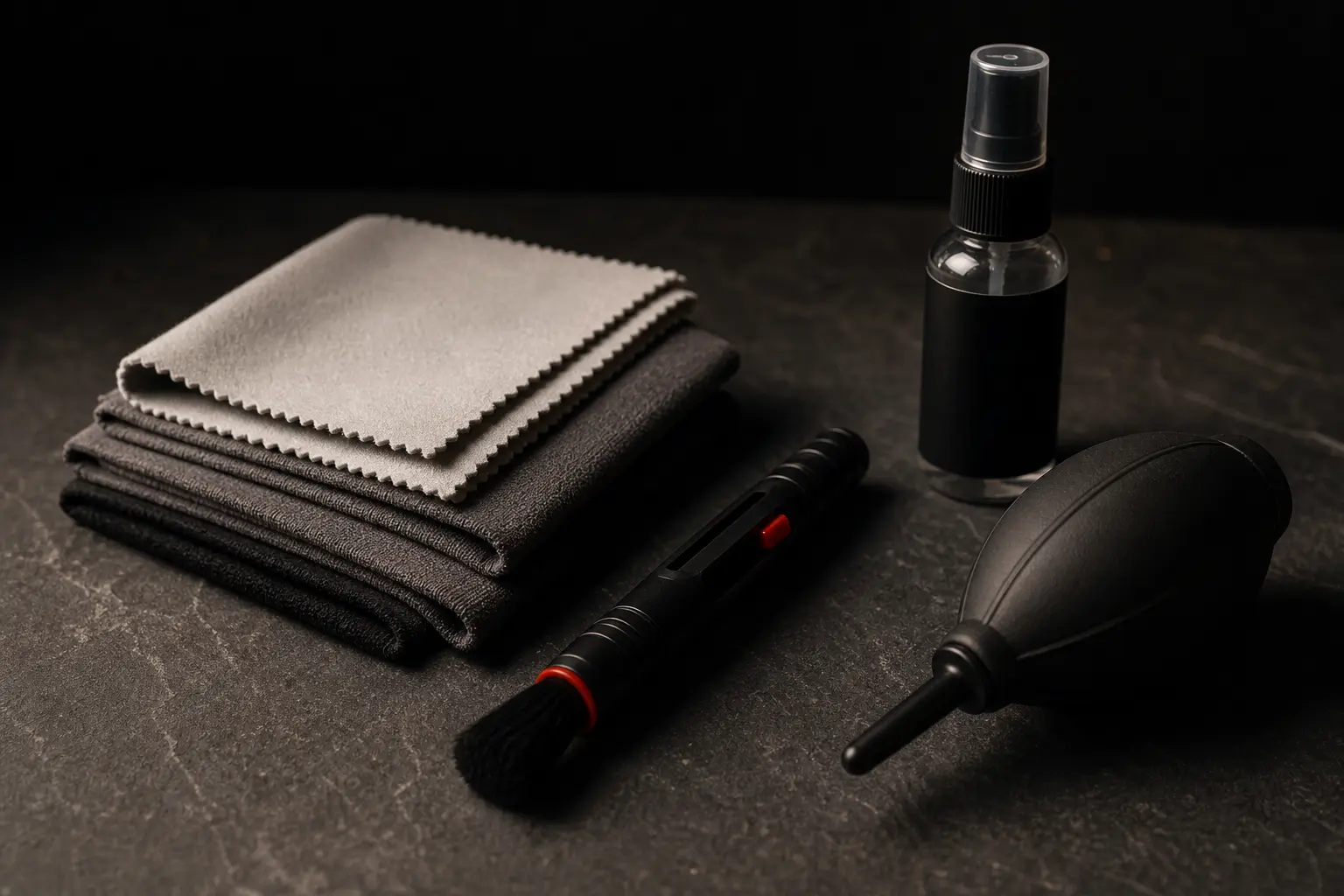
| Tool | Job | Notes |
|---|---|---|
| Microfiber cloths (several) | All routine cleaning | Wash without fabric softener; retire cloths that have picked up grit |
| Blower bulb | Dust removal, step one | Removes the particles that would otherwise be dragged |
| Lens pen | Fingerprints on the go | Carbon tip lifts oils; retract/cover when stored |
| Distilled water | Dampening for grime | No mineral residue; apply to the cloth, never the frame |
| Coated-lens spray (alcohol-free) | Stubborn oily film | Check the ingredient list — "optical safe" must mean no alcohol/solvents |
Notice what the table doesn't contain: no pre-moistened wipes (the convenient ones are alcohol-based), no tissues or napkins (wood-pulp fiber is an abrasive), no household glass cleaner (ammonia), no eyeglass spray of unknown provenance. The toolkit costs about the same as one replacement lens repair. OUR ANALYSIS
03The Routine, Step by Step
Step 1 — blow. Bulb blower, or a gentle breath from a distance for field cleaning. Every dust particle you remove here is a scratch that can't happen; every one you don't becomes the grit under your next wipe. OUR ANALYSIS
Step 2 — dry microfiber, light circles. Fold the cloth into a pad, use the clean inner face, work from the center outward with pressure you'd apply to a phone screen. Most smudges end here. OUR ANALYSIS
Step 3 — damp for grime. Sunscreen, skin oil, fingerprint crust: dampen a corner with distilled water (or a drop of lens soap in it), clean in circles, then dry-buff with a dry corner. Apply liquid to the cloth — never to the glasses, whose seams, ports, and (on camera glasses) button gaps don't want a stream. OUR ANALYSIS
Frequency: clean when you see smudges, not on a calendar. The failure mode to avoid is the emergency wipe with whatever's at hand — which is how most coating damage happens, in one second, at a restaurant table. OUR ANALYSIS
Our pick
Microfiber cloth 12-pack
The whole routine starts here
A stack of clean microfiber cloths is the one purchase that prevents most coating damage. $8-14.
Check price on AmazonRetailer links may earn us a commission — price approx., check retailer.
04Per-Category Differences
Display glasses (XREAL, VITURE, Rokid Max, RayNeo): the routine above, plus two cautions — keep liquid away from the nose-pad arms and cable port, and clean the inner combiner surface gently if your model exposes it (visible through the lens at an angle). Never spray anything at the frame seams. MFR SPEC
Camera glasses (Ray-Ban Meta, Oakley Meta): the lenses themselves are eyeglass-standard — clean as you would prescription glasses — but the temples carry electronics, mics, and buttons: no submersion, no running water, no spray directed at the hinges. Meta's care guidance is the same spirit: cloth-based cleaning, keep liquids away from the electronics. MFR SPEC
Prescription inserts: standard coated eyeglass lenses — same no-alcohol rule, same routine, and our inserts guide covers their care and ordering world. Fit questions — nose pads, IPD, strap comfort — live in our returns-and-fit guide. OUR ANALYSIS
05What Actually Damages the Optics
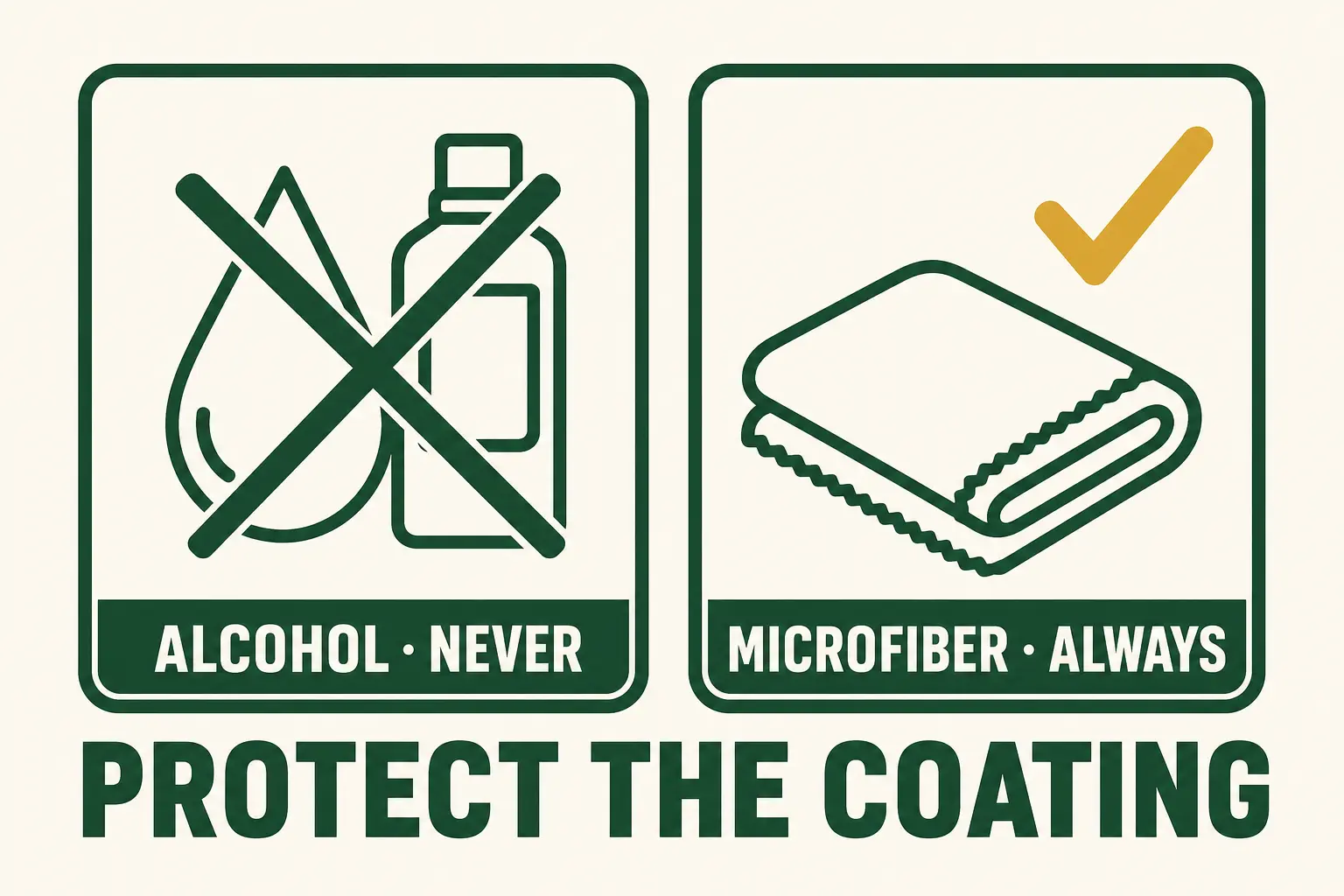
Alcohol and solvents are the headline: coating stacks are engineered to transmit specific wavelengths with specific adhesives, and solvent exposure degrades them — sometimes visibly (haze, peel at the edge), sometimes as a slow loss of contrast you blame on the display. Acetone and ammonia are the aggressive extremes; "lens wipes" that smell medicinal are the stealth version. The check that never fails: read the ingredients. OUR ANALYSIS
Abrasion is the volume killer: shirt tails, paper towels, napkins, tissues — wood-pulp and woven fibers micro-scratch coatings in patterns that read as permanent haze under the bright light path. A single emergency shirt-wipe is survivable; a habit of them is how "my glasses got cloudy" starts. OUR ANALYSIS
Sweat and salt water corrode frames and coat lenses with a film that needs the damp routine, not a dry rub — owners of camera glasses used for workouts report salt residue degrading lens clarity until properly cleaned, and eventually edge corrosion on the frame itself. Rinse-rule for exposure: damp microfiber promptly, dry thoroughly. OWNER REPORTS
Heat — the dashboard car test — stresses both coating adhesives and battery cells. A hard case in the cabin, not the glovebox, is the summer rule. OUR ANALYSIS
fit problems that cleaning can't fix → what those coatings actually do →
Decoded verdict
Two purchases and two habits
Buy a stack of microfiber cloths and a blower bulb; adopt the blow-first habit and the read-the-ingredients habit. That is the entire maintenance cost of keeping smart-glasses optics clean for the life of the device. Everything else in this guide is the catalog of what happens to people who skip those four things — and the one-sentence version is: solvents kill coatings, fibers scratch them, and no cleaning product fixes damage that has already happened.
Provenance: in-box cloth inclusion is from XREAL's official items list; brand care guidance summarized from manufacturer support pages; the mechanism claims (coating degradation, abrasion, heat stress) are standard optical practice labeled as our analysis; sweat-corrosion behavior is owner-reported and labeled as such.