Field of view: the spec that decides how big your screen feels
Inches lie, resolution gets the headlines, but FOV is the number that determines whether display glasses feel like a TV across the room or a private cinema.
On this page
Field of view is the angular size of the image the glasses paint into your vision, measured in degrees. It's the single most honest number in smart-glasses marketing: resolution can be fudged with panel binning, inches can be invented with geometry, but a 50° view is a 50° view. If you understand FOV, you can compare any two pairs of display glasses from their spec sheets and predict the experience surprisingly well.
01What FOV actually measures
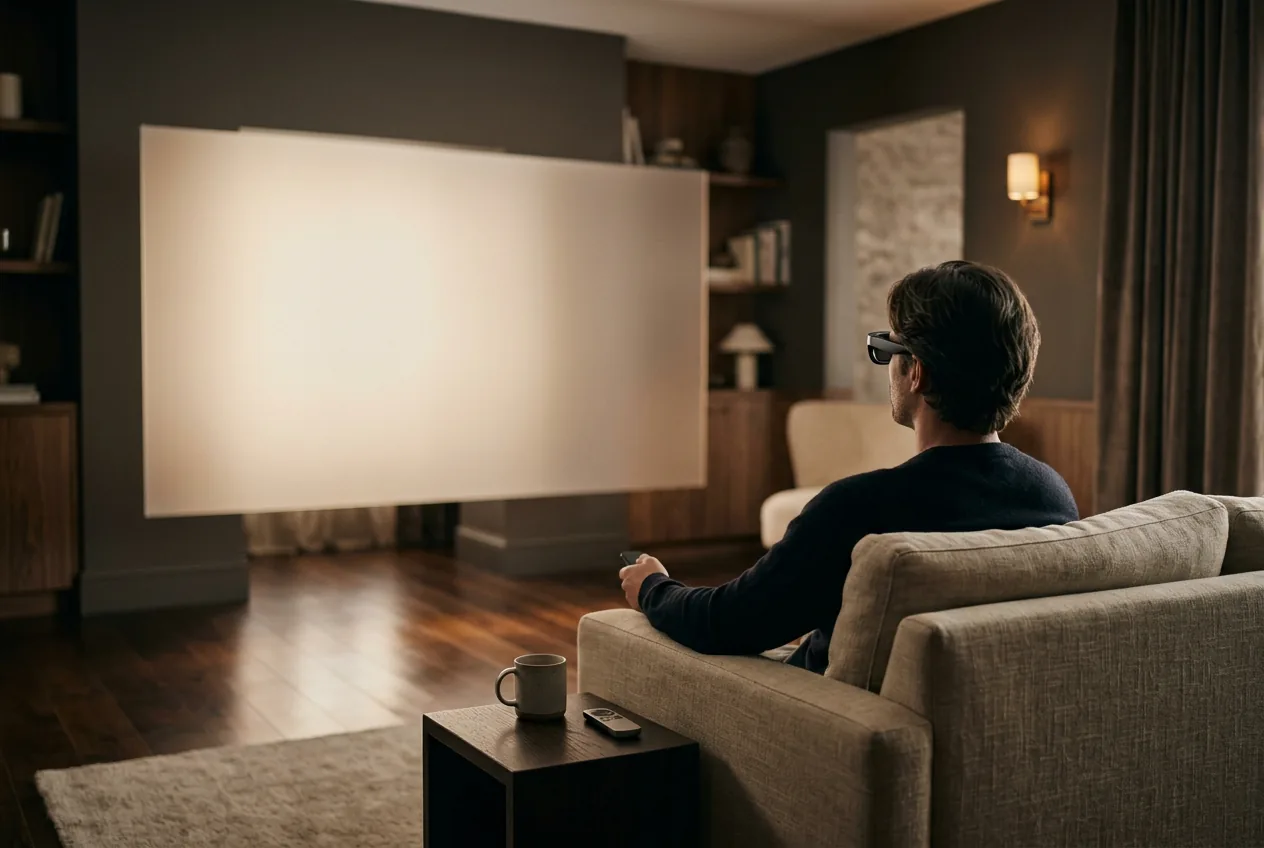
Hold your arms straight out and spread them until they mark the edges of what you're looking at — that's an angle, and that's FOV. Human binocular vision covers roughly 114° horizontally (200°+ including periphery), a large theater screen from the middle rows fills about 45–60°, and a laptop at arm's length fills around 40–45°. That's the mental model: mainstream display glasses in 2026 put a cinema-scale image in the upper band of that range, which is why they feel immersive despite being 1080p panels.
- 46° — RayNeo Air / Air 2 Pro class
- 50° — XREAL One / 1S / VITURE Pro 2
- 57° — XREAL One Pro
- 58° — VITURE Beast
The vertical dimension matters too — most birdbath displays are 16:9 — but manufacturers quote the diagonal, same as TVs. When we say 57° vs 50°, we mean diagonal FOV; horizontally the difference is roughly 50° vs 44°, about the same proportional jump as a 65-inch TV versus a 55-inch at identical distance. MFR SPEC
02The 2026 FOV ladder
Where the current tethered market stands, top to bottom:
- 58° — VITURE Beast ($549): the widest mainstream view, paired with 1920×1200 per eye and 1250-nit panels. April 2026's spec flagship. MFR SPEC
- 57° — XREAL One Pro ($599): essentially tied, sold in two IPD sizes (M: 57–66 mm, L: 66–75 mm) to protect edge sharpness at the wider angle. MFR SPEC
- 50° — XREAL One ($399), XREAL 1S ($449), VITURE Pro 2 ($299): the sensible middle. Big enough for cinema feel, light enough (63–84 g) for long sessions.
- 46–48° — RayNeo Air 2s / Air 3s / Air 4 Pro, Rokid Max 2, XREAL Air 2 Pro: the budget and legacy tier. Perfectly watchable; noticeably more “big TV” than “private cinema.”
- 20° diagonal — Meta Ray-Ban Display ($799): the reminder that FOV defines the category too. At 20° (about 14° horizontally), Meta's hybrid is a notification viewfinder, not a screen — brilliant for its purpose, but a different product from everything above. MFR SPEC
03Why inch claims mislead
“215-inch screen!” “174-inch display!” These numbers are computed from FOV at an assumed virtual distance — and the assumption is the whole game. The same 50° optics can be honestly described as 120 inches at 3 meters or 300 inches at 7.5 meters, because apparent size shrinks with distance. Brands pick whichever arithmetic sounds best, which is why the XREAL One (50°) has been marketed with inch claims ranging from 147 to 300+ across different campaigns and why comparing VITURE's “174-inch” against RayNeo's “201-inch” tells you almost nothing.
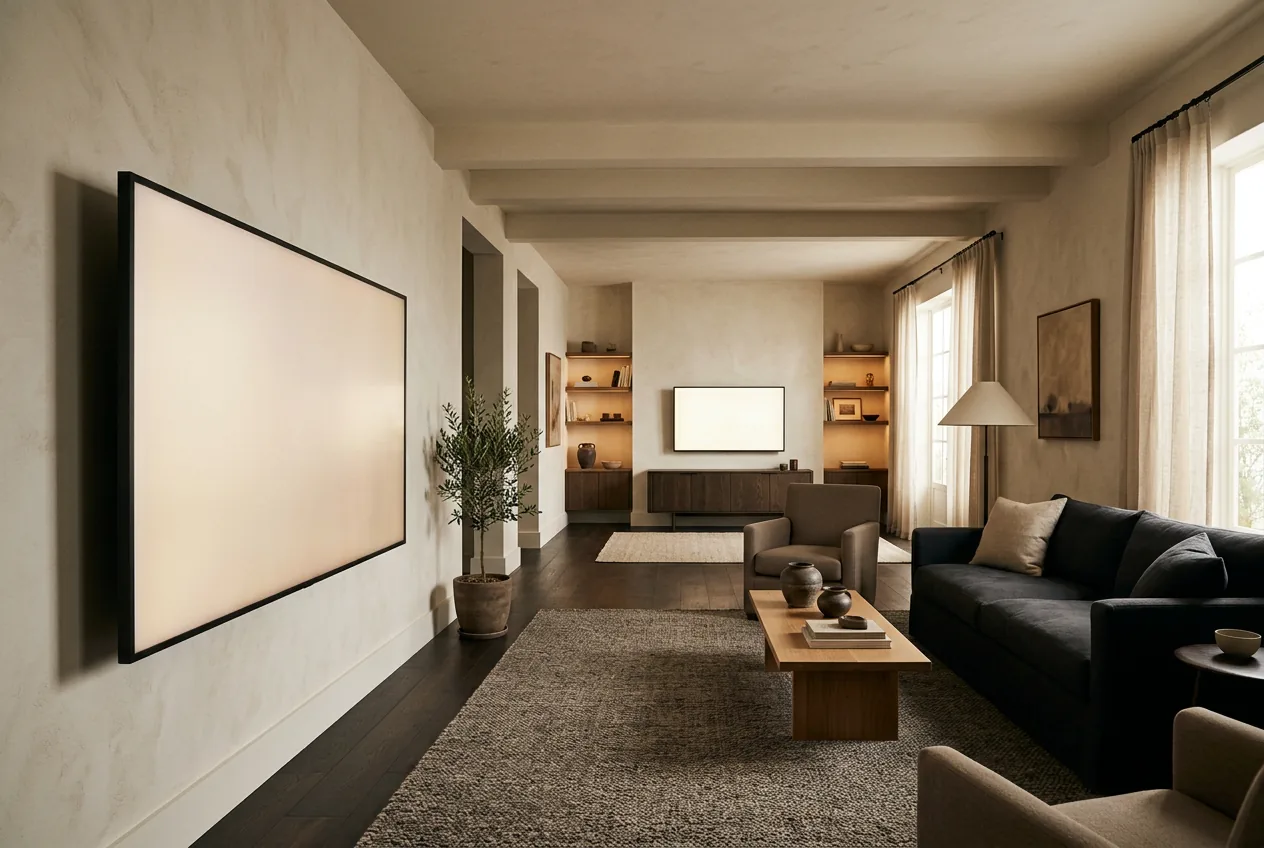
The fix is to compare FOV first, resolution per eye second, inches never. FOV tells you how much of your vision the image fills; resolution per eye tells you how sharp it is; inches are a unit of marketing. This is also why our comparison tool lists FOV and omits inch claims entirely.
Our pick
XREAL One Pro
$599approx.
The widest tethered view in mainstream glasses: 57° FOV in two IPD sizes.
Check price on AmazonRetailer links may earn us a commission — price approx., check retailer.
04What a wide FOV costs you
FOV isn't free, and knowing the exchange rates makes you a smarter buyer. In birdbath optics (the magnifying-glass approach used by all tethered display glasses), a wider angle requires larger optical elements: the 57–58° flagships weigh 87–88 g while 50° models run 63–84 g and 46° models sit at 75–76 g. Heavier glasses mean more nose pressure and faster fatigue — the most common long-session complaint in owner reports. OWNER REPORTS

Wider FOV also stresses edge sharpness: light at the periphery of a wide birdbath takes a longer optical path, which is why XREAL sells the One Pro in two IPD sizes and why some XREAL 1S owners report softer edges than One Pro owners despite the 1S's sharper 1920×1200 panels. Per-eye resolution and optical quality trade against angle; the 2026 flagships charge $549–599 partly to buy out of that trade-off. Whether that's worth it depends on whether your sessions are 20-minute gaming bursts (weight doesn't matter, immersion does) or three-hour flights (the reverse).
05FOV's partner: pixels per degree
The sharpest way to compare displays is pixels per degree (PPD): resolution divided by FOV. Roughly: XREAL 1S (1920×1200 over 50°) ≈ 38–40 PPD horizontal; XREAL One (1920×1080 over 50°) ≈ 36; VITURE Beast (1920×1200 over 58°) ≈ 34–36; Meta Ray-Ban Display achieves 42 PPD over its tiny 20° FOV — which is why its small image looks so crisp. Healthy desktop monitors land around 50–60 PPD at typical viewing distances, so even the best glasses read as “good laptop panel,” not “retina.” That's the honest reason text-work favors the 1200p models and why nobody should buy display glasses expecting 4K crispness. OUR ANALYSIS
Our pick #2
XREAL One
$399approx.
The safe default: sharp 50° display with spatial smarts built into the glasses.
Check price on AmazonRetailer links may earn us a commission — price approx., check retailer.
Frequently asked questions
What field of view do XREAL One glasses have?
Is a bigger FOV always better?
How does FOV relate to the 'inch' screen sizes brands advertise?
Our pick #2
XREAL One
$399approx.
The safe default: sharp 50° display with spatial smarts built into the glasses.
Check price on AmazonRetailer links may earn us a commission — price approx., check retailer.