Are AR glasses bad for your eyes? An evidence-tiered answer
The documented complaints are comfort-level — strain, headaches, dryness — tied largely to fit and IPD. Lasting harm is not established, and this page carries no affiliate links: just the evidence, tiered by how strong it is.
On this page
- 01 What the evidence actually says
- 02 What the hardware actually is
- 03 The documented complaint patterns
- 04 The blue-light question: evidence vs. marketing
- 05 IPD: the most mechanical comfort factor
- 06 If you wear prescription glasses
- 07 Kids and teens: unsettled by definition
- 08 Practical comfort rules
- 09 When to see an eye-care professional
Search “are AR glasses bad for your eyes” and you find two things: vendor blogs selling reassurance, and VR-headset research stretched past its scope. This page is the third thing — an evidence-tiered answer that says plainly what is known, what is claimed, and what nobody honestly knows yet. It carries no retailer links by design.
The 30-second answer
The documented issues with display glasses are comfort-level: eye strain, fatigue, headaches, and dryness — tied largely to fit, IPD mismatch, and unbroken near-focus. The evidence for lasting harm from near-eye displays is not established: no long-term studies exist, and no authority has issued a display-glasses-specific statement. Anyone claiming certainty in either direction is ahead of the science.
01What the evidence actually says
Start with what eye doctors actually document. The American Academy of Ophthalmology describes digital eye strain as real but comfort-level: its drivers are reduced blinking and prolonged near-focus, and the Academy is explicit that screen light itself is not the cause. The remedies it names are unglamorous — breaks, correct prescriptions, blinking, positioning — not avoidance.
On head-worn displays specifically, the Academy’s statement covers VR headsets: “No long-term studies exist, but ophthalmologists agree there is no reason to be concerned that VR headsets will damage eye development, health, or function,” with temporary strain and fatigue possible. That is the strongest authority in this niche, and note its scope honestly: it addresses VR headsets. Display glasses differ optically — more on that below — and no authority has issued a display-glasses-specific statement. The closest available evidence is VR and near-eye-display research, and it points the same way: a 2024 study found eye strain, headache, and dizziness after brief near-eye sessions — transient, comfort-level effects that resolve.
So the tiered answer reads: strain and fatigue are documented and temporary; lasting damage is not established — and its absence is not established either, because the long-term studies simply have not been run. Based on the available evidence — which covers VR headsets and near-work research, not display glasses specifically — the sensible posture is comfort vigilance, not fear.
02What the hardware actually is
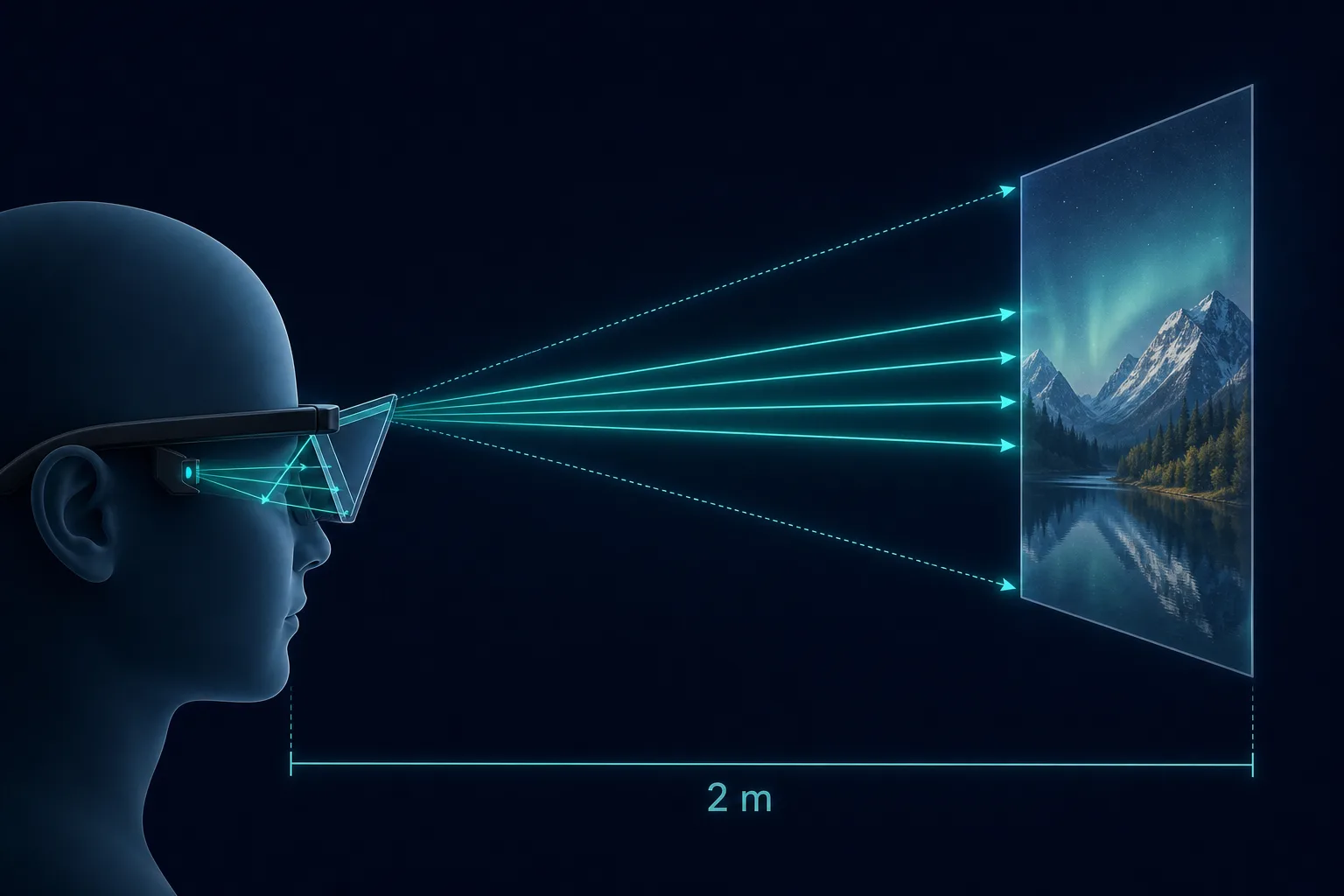
The fear image — a screen glued to your eyeball — is not what ships. Every mainstream tethered display pair uses micro-OLED panels behind birdbath optics: the panel sits above your eye and folded optics place the image a meter or more in front of you. Owner measurements of current birdbath models put the virtual image at roughly two meters, matching the manufacturer-stated virtual image distances. MFR SPEC Optically, that is closer to watching a TV across the room than to staring at a phone an inch away — how the trick works is in our display-technology explainer.
Two honest caveats. First, near-focus is still near-focus: your eye accommodates and your eyes converge onto that virtual image for hours, which is the same muscle budget as any screen work — the distance softens it, it does not erase it. And 2D screen mirroring holds a single fixed focal plane, which sidesteps part — not necessarily all — of the strain drivers documented in stereoscopic headsets. Second, this is hardware with mass: current birdbath pairs run 63–88 g on the nose, and pressure points are their own comfort complaint. MFR SPEC
03The documented complaint patterns
The symptom profile reported by owners matches the clinical picture of digital eye strain from the 2022 comprehensive review: eye strain, headaches, dryness, and blurred vision, plus motion discomfort in some users during camera-moving content. OWNER REPORTS None of these is exotic — and what matters is what drives them:
- Fit. A frame that slides pumps tiny misalignments into every frame of video; nose-pad pressure and weight add their own fatigue over long sessions.
- IPD mismatch. If the optics don’t match your pupil gap, edges blur and ghost, and your visual system works overtime to fuse them — the single most reported mechanical cause of strain and headaches. OWNER REPORTS
- Vergence–accommodation demand. A 2021 review documents the vergence–accommodation conflict as a real, unsolved cause of visual fatigue in stereoscopic near-eye displays. REVIEWS
- Reduced blinking and unbroken sessions. The Academy’s strain drivers — blink less, focus near for hours — apply to a virtual screen exactly as to a laptop. OUR ANALYSIS
Read together, the honest summary is: headaches are a yes-when-misfit phenomenon — common when fit, IPD, or session length are wrong, and largely addressable when they are right. That is very different from “these glasses damage eyes,” for which the evidence does not exist in either direction.
04The blue-light question: evidence vs. marketing
Blue light is where the most confident claims meet the least evidence. What the evidence says: the American Academy of Ophthalmology states digital eye strain is not caused by screen light and does not recommend blue-light-blocking glasses for it. What marketing says: certification badges. The XREAL One series carries TÜV Rheinland Eye Comfort (AR), Low Blue Light, and Flicker Free certifications — the first AR glasses with two certification sets, per the certifier’s own release — and VITURE markets its Pro/One line as “SGS A+ certified to cause less eye strain than your phone.” MFR SPEC
Read those as claims, precisely: certifications verify measured emission and flicker characteristics of the product. They are not health guarantees, and no certified low-blue-light mode in these specific products has been shown to produce a comfort or health outcome. If eye strain is your worry, the levers with evidence behind them are fit, breaks, and blinking — not lens tint. OUR ANALYSIS
Our pick
XREAL One
$399approx.
The safe default: sharp 50° display with spatial smarts built into the glasses.
Check price on AmazonRetailer links may earn us a commission — price approx., check retailer.
05IPD: the most mechanical comfort factor
Interpupillary distance — the millimeter gap between your pupils — is where comfort is won or lost. Birdbath optics focus the panel through a lens pair tuned to a design IPD; when yours differs, the sharpest part of the image lands off your pupils and the edges blur or double. Owner reports consistently rank this first among mechanical strain causes, and it is invisible at the store: a misfitted pair looks fine for ten minutes and punishing at hour one. OWNER REPORTS
The market’s answer is mostly absent: most fixed-frame pairs publish no IPD range and target the mid-50s-to-70 mm zone where most faces sit. The exception is the XREAL One Pro, sold in two sizes — M for 57–66 mm, L for 66–75 mm — which is exactly why sizing exists at all. MFR SPEC Measure before you buy (mirror and ruler works; an optician’s number is better — it is often printed on your prescription): the full method is in our IPD guide.
This is also why manufacturer age floors matter — children’s IPDs average smaller than the bands these optics cover, which we take up next.
Our pick
XREAL One
$399approx.
The safe default: sharp 50° display with spatial smarts built into the glasses.
Check price on AmazonRetailer links may earn us a commission — price approx., check retailer.
06If you wear prescription glasses
An uncorrected prescription is its own eye-strain engine: forcing your eyes to fight a virtual display through the wrong lenses for hours. The fix landscape, based on published specifications, owner reports, and stated criteria:
- Diopter dials — built-in focus wheels on some models. The ranges are real but bounded and mostly exclude astigmatism: the VITURE Pro 2 dials run 0 to −5.00 D (myopia only), the Rokid Max 2 tops out at −6.00 D per eye, and the RayNeo Air 4 Pro accepts swappable dials up to −8.00 D. Check the stated range before counting on dials. MFR SPEC
- Prescription inserts — snap-in frames that carry your full lenses, astigmatism included. Nearly every birdbath display pair supports them; this is the surer path for anyone beyond mild myopia. The trade is a small upfront cost and a few grams. The options are in our inserts guide.
- Wearing your glasses underneath — workable for occasional sessions if the frame allows it, with real costs: added pressure points, fogging, and a fit reset every time. The honest mechanics are in our underneath guide.
07Kids and teens: unsettled by definition
The honest position on children is extra caution with unsettled evidence. Manufacturer age floors (typically 12–13+) reflect fit and IPD considerations more than proven risk; long-term child studies are still lacking, though short controlled studies have found no negative effects. REVIEWS Concretely: guidance relayed from the American Academy of Pediatrics attributes the floors to headset-style fit and IPD, a 2021 review flags concerns about the immature visuomotor system while concluding long-term evidence is missing, and a 2025 five-day study of 10–12-year- olds found moderate daily VR use did not negatively affect visual, physical, or cognitive measures.
Translation for a parent: no one can tell you display glasses are proven harmless for a developing visual system, and no one has documented harm at moderate use either. Follow the manufacturer’s stated age floor, keep sessions short with breaks, prefer well-fitting sizes, and treat any persistent complaints as a stop signal. For a personal decision about a specific child, a pediatric eye-care professional is the right consult — this page does not make it for you.
08Practical comfort rules

Everything documented above collapses into a short checklist, ordered by leverage:
- Match IPD first. Measure before buying, and buy from a retailer with returns — misfit is the one comfort factor you cannot adapt to. Our returns-and-fit guide ranks retailers on exactly this.
- Break on a clock, not on pain. The 20-20-20 habit — every 20 minutes, look at something 20 feet away for 20 seconds — is the standard comfort intervention from the American Optometric Association; the Academy’s VR advice suggests a roughly 30-minute breather.
- Fix the small stuff: seat the nose pads, blink deliberately, keep a correct prescription in the loop, and stop when strain accumulates — strain that fades with rest is comfort feedback, not damage.
20
Minutes between breaks
20-20-20 rule (AOA)
20 s
Looking 20 ft away
lets focus muscles relax
~30
Minute VR-session breather
AAO headset guidance
0
Official hour limits
none exist for display glasses
Note what is not on that list: a safe number of daily hours. No official usage-hour threshold exists for display glasses; the cadences above are borrowed from general near-work and VR guidance because nothing display-glasses-specific has been published. OUR ANALYSIS
09When to see an eye-care professional
Comfort issues that survive the checklist — recurring headaches despite a matched IPD and sane sessions, strain that outlasts rest, lasting blur, double vision, or any symptom that feels new — are not things to push through or self-diagnose from a spec sheet. They are reasons to see an eye-care professional, who can check the basics and rule out the unrelated. That is generic educational guidance, not medical advice: for any personal decision about your eyes, the professional in the chair knows what no article can.
Decoded verdict
Comfort problems are real, common, and mostly fixable — lasting harm is unproven in both directions
The documented failure modes of display glasses are strain, headaches, and dryness, and they track fit, IPD, and session habits — measurable, fixable, ordinary. The long-term picture is genuinely unknown, in both directions, and this page will not pretend otherwise. If you are pre-purchase anxious, spend the anxiety where it pays: measure your IPD, plan your prescription path, and buy where misfit is returnable — the prescription hub and returns-and-fit guide are the two follow-ups that matter.