Android XR: the platform that could reset smart glasses
Google's operating system for spatial devices runs Samsung's headset today, XREAL's next flagship glasses, and Google's own AI eyewear this fall. Here's what it actually is — and what it changes.
On this page
Every platform war starts the same way: fragmented proprietary devices, then one operating system with an app ecosystem and distribution, then everyone else's differentiation collapsing into hardware. Phones went through it (iPhone, then Android, then everyone). Smart glasses are entering that second phase now, and the platform is Android XR — Google's operating system for headsets and glasses, co-developed with Samsung, Qualcomm, and a growing device roster.
01What Android XR actually is
Android XR is an Android branch built for spatial devices: a 3D app model (windows and panels placed in space), Gemini as the built-in assistant, Google's app portfolio adapted (Maps, YouTube, Photos, Chrome in spatial form), and phone pairing for notifications and continuity. For headsets, it's Google's answer to visionOS — the Samsung Galaxy XR ($1,799, October 2025) is the launch device, with 4K micro-OLED panels and an external battery. MFR SPEC
The more consequential half is AI eyewear — glasses-form devices where Android XR provides the brains for camera, assistant, audio, and glanceable display. At Google I/O in May 2026, Google confirmed its first consumer eyewear arrives this fall, with frames from Gentle Monster and Warby Parker, pairing with both Android phones and iPhones. MFR SPEC The strategic move to notice: Google is treating glasses as the next Android device class, not as an accessory — the same playbook that made Android phones commodity-priced and ubiquitous.
02The 2026 device roster
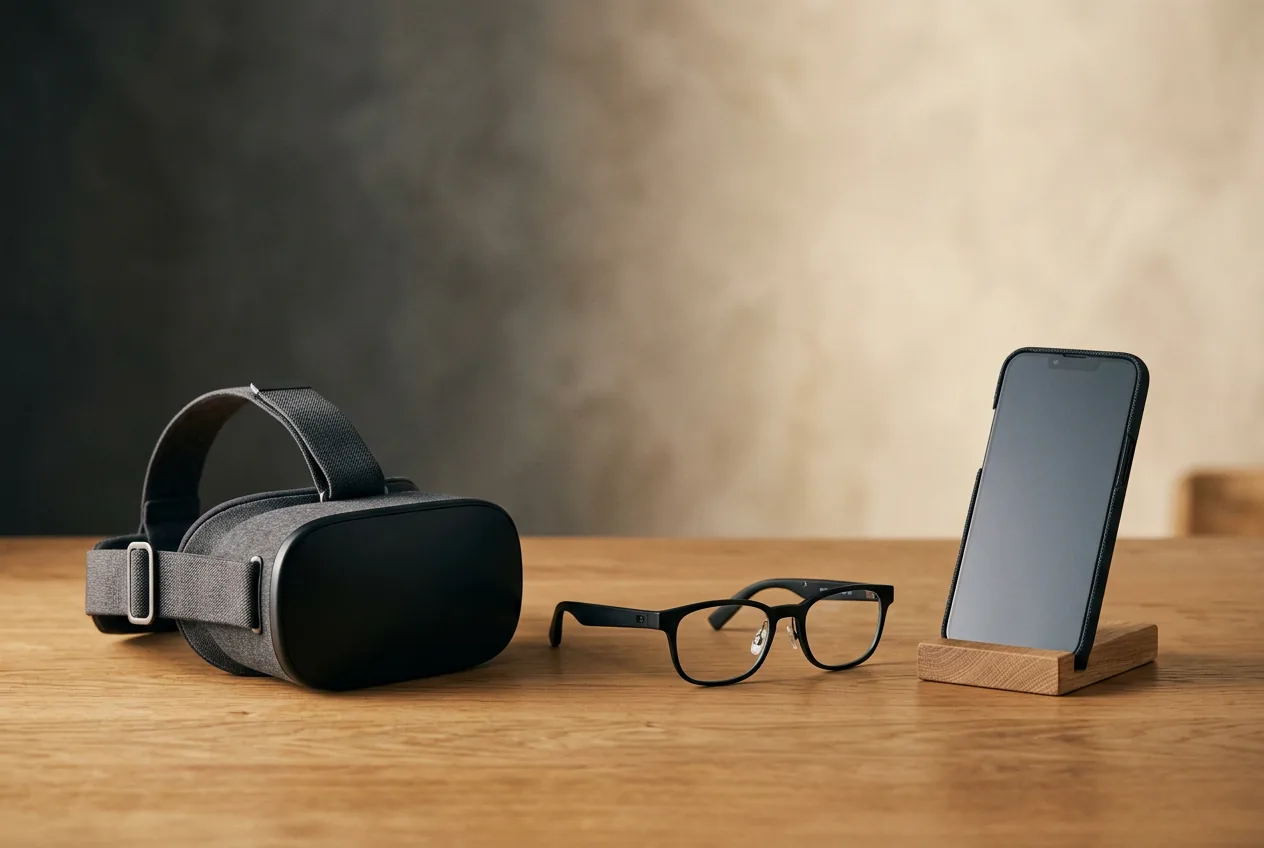
- Samsung Galaxy XR ($1,799, Oct 2025) — the reference headset: 4K-per-eye micro-OLED, ~400 g with external battery, conversational Gemini AI. Shipped with a year of Google AI Pro and YouTube Premium. It's a developer and enthusiast statement, not the mainstream device.
- Google AI eyewear (fall 2026) — camera + assistant glasses in Gentle Monster and Warby Parker frames, positioned against Ray-Ban Meta with Gemini instead of Meta AI. The volume play.
- XREAL Project Aura — the first Android XR display glasses: a 70° FOV binocular device (the widest FOV in glasses, period, when it ships), announced in partnership with Google and Samsung. Pricing unconfirmed; early reports suggest flagship-tier. MFR SPEC
- Samsung's own glasses — two glasses SKUs (SM-O200P/J) have surfaced in regulatory filings, with 2026 shipping windows indicated in those filings; specific hardware details are not yet public. OWNER REPORTS Samsung building both headsets and glasses is the strongest ecosystem signal of all. OUR ANALYSIS
What's not on this list matters too: none of the current tethered display glasses — XREAL One, VITURE Beast, RayNeo Air 4 Pro — run Android XR. They're peripherals, not platforms. That's not a knock: a $299 pair of glasses that works as a monitor with everything you own has a longer useful life than a $599 pair of glasses whose OS support depends on a platform's fortunes.
03Android XR vs the current patchwork
Today's smart-glasses software is a mess of one-off stacks: Meta's locked ecosystem on Ray-Ban; Rokid's Android fork; Even's closed services; XREAL and VITURE's per-platform companion apps; RayNeo's app suite. Android XR promises to standardize the layer where apps, assistants, and pairing live — so a translation app, a teleprompter, or a multi-monitor workspace works across brands the way a podcast app works across phones. For buyers, that's the difference between betting on a device and betting on a category.
The honest caveats: platform promises outrun platform realities for years (ask anyone who bought Wear OS watches in 2014), Google has killed more product categories than most companies have launched, and Meta — the market leader by volume — shows no sign of joining. Android XR's fall 2026 eyewear will be judged on battery life, assistant quality, and whether the app library at launch is real or a graveyard of tech demos. We'll cover the launch in detail when it happens.
Our pick
XREAL One
$399approx.
The safe default: sharp 50° display with spatial smarts built into the glasses.
Check price on AmazonRetailer links may earn us a commission — price approx., check retailer.
04Should you wait for Android XR before buying?
Our rule: buy peripherals on need, platforms on maturity. If you want a private screen for your Steam Deck or a travel monitor this year, current display glasses solve that problem today and lose nothing when Android XR arrives — a monitor is a monitor. If you're specifically excited about AI eyewear (assistant-first, camera glasses), waiting for Google's fall launch is defensible: it's months away, and comparing Gemini-native glasses against Ray-Ban Meta Gen 2 before committing $300–500 is rational patience.
The one cohort that should absolutely wait: anyone about to spend $1,000+ on 6DoF hybrids like the RayNeo X3 Pro specifically for the platform experience. That's a platform purchase, and the platform landscape changes this fall. Everyone else — the Steam Deck owner, the flyer, the multi-monitor seeker — has products that are mature, discounted, and excellent right now. Start from our 2026 picks or the Glasses Finder if that's you.

05Timeline and what to watch
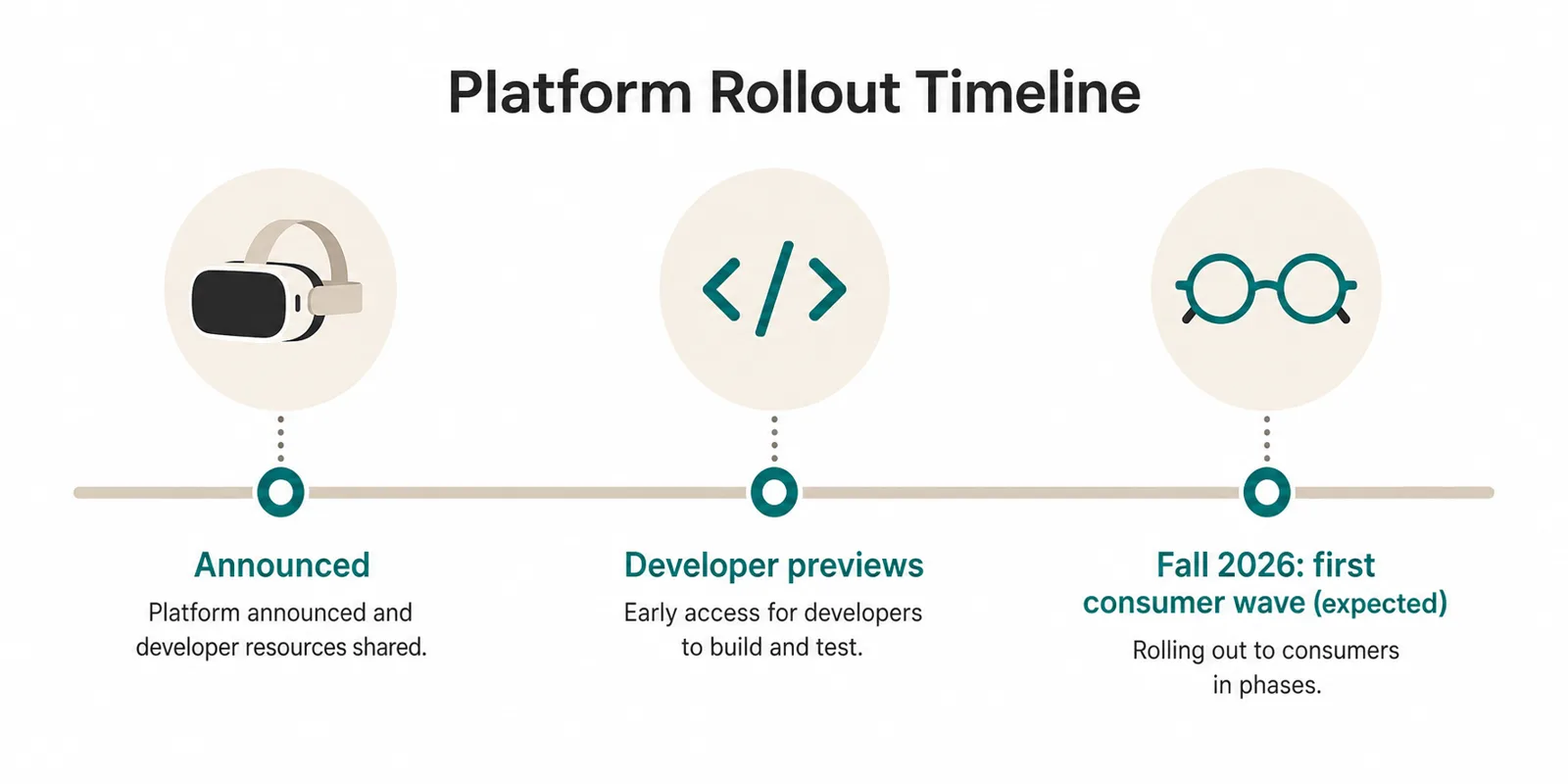
The verified sequence so far: Android XR announced with Samsung (late 2024) → Galaxy XR headset ships (Oct 2025) → XREAL Project Aura partnership announced (Jan 2026) → Google I/O confirms fall 2026 eyewear from Gentle Monster and Warby Parker (May 2026) → fall 2026: Google's first eyewear, plus whatever Samsung's two glasses SKUs (SM-O200P/J) turn out to be. OWNER REPORTS Watch three signals at launch: price (sub-$400 changes everything; $599+ keeps it early-adopter), battery (all-day or not), and iPhone pairing depth (full or crippled — the single best predictor of whether this stays a niche).
Our pick #2
Ray-Ban Meta (Gen 2)
$409approx.
The default AI camera glasses: better battery, 3K video, huge style range.
Check price on AmazonRetailer links may earn us a commission — price approx., check retailer.
Frequently asked questions
When do Android XR smart glasses launch?
Will Android XR glasses work with my phone?
Do current XREAL or VITURE glasses run Android XR?
Our pick #2
Ray-Ban Meta (Gen 2)
$409approx.
The default AI camera glasses: better battery, 3K video, huge style range.
Check price on AmazonRetailer links may earn us a commission — price approx., check retailer.