Smart glasses vs VR headsets: the honest comparison
They both put screens on your face, and that's where the similarity ends. Headsets give you worlds; glasses give you screens. Here's the full trade — comfort, immersion, content, price — and who each one is for.
On this page
“Should I get smart glasses or a Quest?” is usually the wrong question — the products overlap the way a motorcycle overlaps with a canoe (both “vehicles”) — but it's the question people ask, because both categories put displays on your face at overlapping prices. This guide treats the comparison properly: what each product fundamentally is, what each wins at, and the comfort/content/price math that settles it for you.
The 30-second answer
Buy glasses if your use case is travel, flights, handheld gaming, private desk work, or couch viewing — a private screen you wear (63–88 g), $159–599. Buy a VR/MR headset if you want VR games, fitness, sims, room-scale MR, or spatial media — experiences glasses categorically cannot deliver, worth the weight and price for the people who want them. Many enthusiasts end up owning both.
Retailer links may earn us a commission — price approx., check retailer. Both lines refreshed in 2026 — this comparison tracks the current generation, not last year’s.
01The fundamental difference
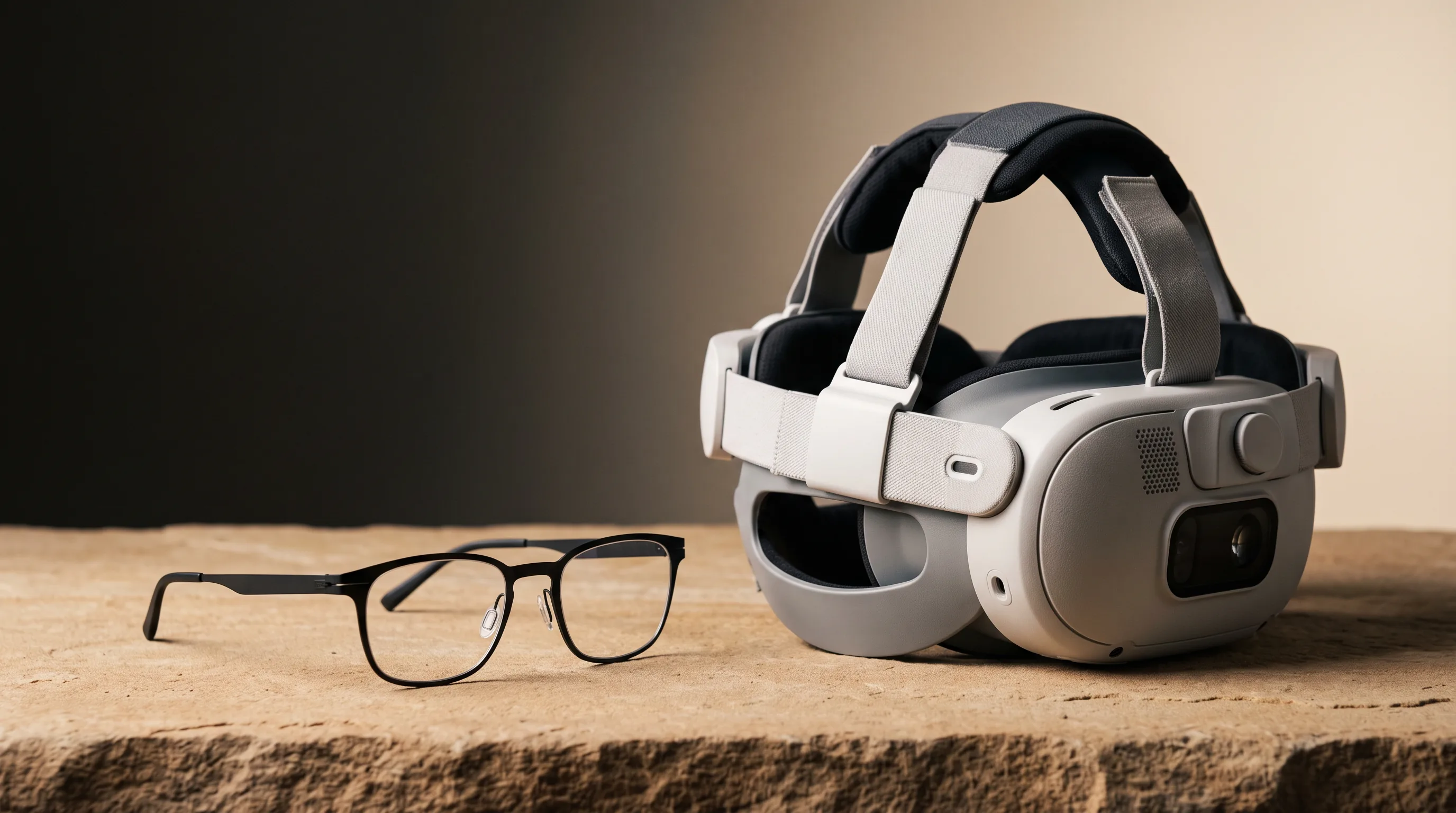
A VR/MR headset is a self-contained spatial computer: tracked in 6DoF, controllers or hand-tracking, opaque displays that replace the world, its own app store and runtime. You enter it. A display-glasses pair is a peripheral: a wearable monitor that shows what your devices send, transparent enough to see through, 2D (with 3DoF anchoring at best), no controllers, no runtime, no world. You look through it. Everything else — weight, comfort, content, price — cascades from that difference.OUR ANALYSIS
02The comparison table
| Display glasses | VR/MR headsets | |
|---|---|---|
| Weight | 63–88 g | ~400 g (Galaxy XR) to 600–800 g (Quest 3, Vision Pro class) |
| Display | 1080p–1200p per eye, transparent, see-through | 2K–4K per eye, opaque, world-replacing |
| Tracking | 0–3DoF (mirror to anchored screen) | 6DoF + controllers/hands |
| Content | Your devices: consoles, PCs, phones, handhelds | Its own store: VR games, MR apps, spatial media |
| Session comfort | Hours (with weight-fit caveats) | 45–90 min typical before face fatigue |
| Price (2026) | $159–599 | $299 (Quest 3S) to $1,799 (Galaxy XR) to $3,499+ (Vision Pro class) |
| Battery | Draws from source device (untethered time = your device's) | 2–3 h onboard; tethered for long sessions |
| Social acceptability | Glasses-shaped; mild | Full face computer; total |
MFR SPEC — figures from current manufacturer specs; the Galaxy XR's ~400 g with external battery is the lightest modern headset-class attempt, and it's still 5× a glasses pair.
03What each one wins
Glasses win: travel and flights (the category's killer app — no comparison); handheld gaming (Steam Deck + glasses is the best mobile gaming rig in consumer tech); private desk work in shared spaces; couch gaming when the TV is occupied; anything involving being a person in the world while watching a screen.

Headsets win: VR games and fitness (the entire genre); room-scale MR (placing virtual objects in your actual room); cinematic 3D content; simulator-grade immersion (racing/flight sims with wheels and HOTAS); spatial media and 180° video; social VR. Notice the pattern: everything on the headset side requires 6DoF and content designed for it — the glasses side is everything that's fundamentally a screen you'd otherwise watch elsewhere.
Our pick
XREAL One
$399approx.
The safe default: sharp 50° display with spatial smarts built into the glasses.
Check price on AmazonRetailer links may earn us a commission — price approx., check retailer.
04The comfort reality nobody specs
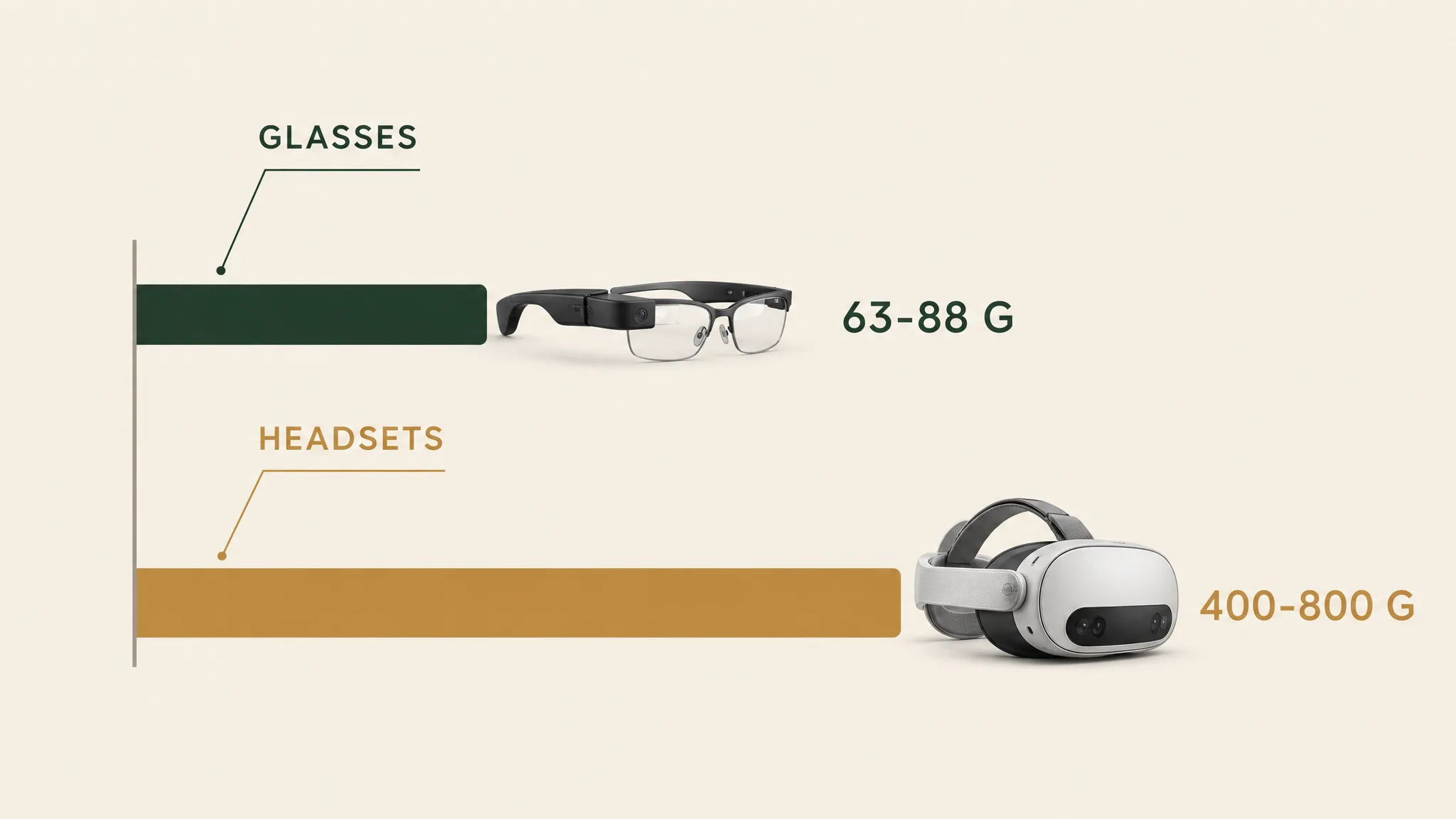
The numbers understate the difference. Headsets seal against your face (light-leak management, foam pressure, heat build-up) and concentrate their mass on a forehead strap — 45-to-90-minute sessions are the norm before fatigue, and “VR face" is real. Glasses distribute 63–88 g on your nose like heavy sunglasses; two-hour movies are routine, and the failure mode is nose pressure, not face fatigue. The honest inversion: headset immersion demands the enclosure that makes it uncomfortable; glasses' transparency is both their comfort and their ceiling — you can see the world, and the world can't be replaced by content. OWNER REPORTS
05The verdict
Buy glasses if…
- → Your answer involves travel, flights, Steam Deck, private screen, or couch
- → You want hours of comfort — 63–88 g vs a 400–800+ g face seal
- → You want a $159–599 screen that mirrors devices you already own
Buy a headset if…
- → Your answer is VR games, fitness, sims, room-scale MR, or spatial media
- → You want 6DoF immersion and tracked controllers — glasses cannot deliver this
- → You’ll accept 45–90 min sessions and a 400–800 g face computer
Headsets run $299–3,499+ — not our affiliate lane
Bottom line
Screens → glasses ($159–599) · Worlds → headset ($299–3,499+) · Overlap is small but real — many enthusiasts buy both.
OUR ANALYSISDecoded verdict
Not competitors — a Venn diagram with a small overlap
Buy glasses if your honest answer to “what will I do with it?” involves the words travel, flight, Steam Deck, private screen, or couch. You'll use them weekly, they cost $159–599, and they solve real problems nothing else solves.
Buy a headset if your answer involves VR games, fitness, sims, room-scale mixed reality, or spatial media — experiences glasses categorically cannot deliver, worth the weight and the price for the people who want them.
Buy both, eventually, if you're the enthusiast type — the overlap (big virtual screens) is real but small, and owning both categories costs less than one Vision Pro. In 2026 that's not a joke; it's the market's structure. Start with the Glasses Finder or our category-ranked picks for the glasses side of the decision.
Our pick #2
VITURE Pro 2
$299approx.
The 2026 budget king: 63 g, diopter dials, 120 Hz — $299.
Check price on AmazonRetailer links may earn us a commission — price approx., check retailer.
Frequently asked questions
Are smart glasses better than VR headsets?
Can smart glasses play VR games?
What's more comfortable for movies on a plane?
Is a VR headset or smart glasses better for a big virtual monitor for work?
Our pick #2
VITURE Pro 2
$299approx.
The 2026 budget king: 63 g, diopter dials, 120 Hz — $299.
Check price on AmazonRetailer links may earn us a commission — price approx., check retailer.