Rokid Max 2 vs XREAL One: dials versus spatial smarts
The Max 2 corrects your vision with dials in the frame and weighs 9 g less; the One anchors your screen in space the moment you plug in. Both are 1080p USB-C monitors — here's where each pair wins, loses, and outright fails, decided on published specs, owner reports, and stated criteria.
On this page
Two tethered 1080p Micro-OLED monitors, two very different bets on what makes display glasses worth wearing: the Rokid Max 2 puts its engineering into your vision — diopter dials built into the frame — while the XREAL One puts it into the screen’s behavior, anchoring your view in space with an onboard chip. Same resolution, same USB-C tether, same 120 Hz ceiling. The right pick depends on your eyes and your devices, not on either brand’s hero number.
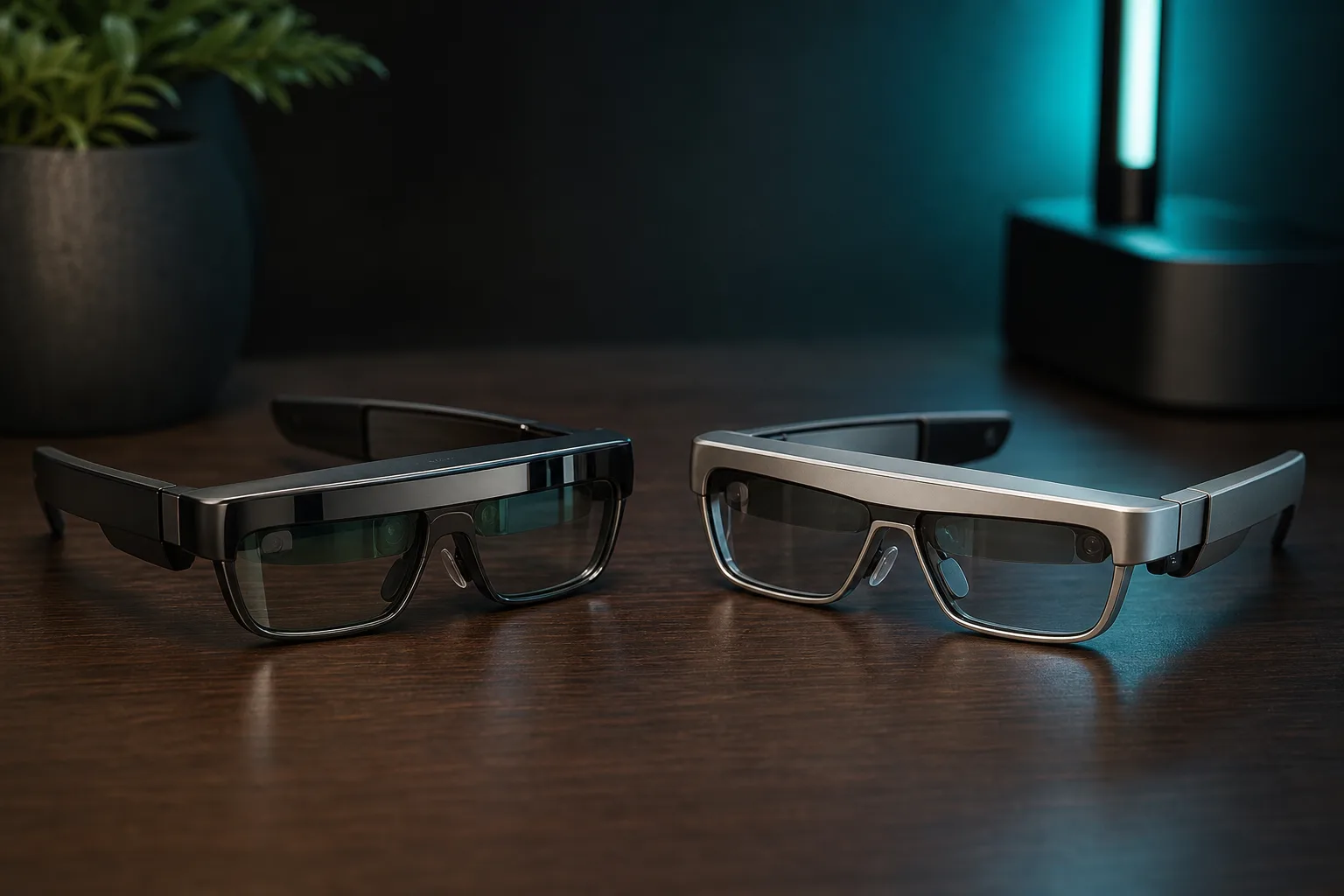
Buy the Rokid Max 2 if you’re nearsighted anywhere in the 0 to −6.00 D range and want to skip prescription inserts entirely — its per-eye dials are the deepest built-in correction among mainstream display glasses — or if you want the lighter carry at a stated 75 g versus the One’s 84 g. It lists at $429 — but in September 2026 Rokid’s own store was running it at $279 on sale (35% off), and US retail has commonly sat in the $279–399 band. The trade: full 3DoF screen anchoring requires Rokid’s separate Station 2 hub at about $239, and Rokid’s western retail and support footprint is smaller than XREAL’s. MFR SPEC
Buy the XREAL One if you want spatial anchoring that works the moment you plug in — the onboard X1 chip holds the screen in place from any USB-C video source, no hub and no app required. It’s the lower-friction pick for Steam Deck, laptop, and plane use, its 50° field of view is a firm spec rather than a range, and its $399 price (cut from $499 in December 2025) undercuts the Max 2’s list. The trade: no built-in diopter dials, nine more grams on your nose, and 1080p-per-eye text that’s good but not class-leading.MFR SPEC
The 30-second answer
Both are USB-C DisplayPort Alt Mode displays — neither is standalone — and both render 1920×1080 per eye on Micro-OLED at up to 120 Hz. So this decision is not about raw image quality. It’s about correction (the Max 2’s dials), comfort (75 vs 84 g), and spatial features (the One’s onboard; the Max 2’s behind a $239 hub).
Retailer links may earn us a commission — price approx., check current price before deciding. Prices verified September 2026; both brands have cut prices before.
01Spec for spec: the whole gap on one table
Start with the shared ground, because it’s most of the product. Both glasses are tethered monitors that draw video and power from a single USB-C cable and need a DisplayPort Alt Mode source — a laptop, a Steam Deck, a compatible Android phone, or a handheld PC. Both render 1920×1080 per eye on Micro-OLED at up to 120 Hz, both live in the 600-nit class, both have fixed single-size frames, and both accept prescription inserts. MFR SPEC
| Rokid Max 2$279 | XREAL One$399 | |
|---|---|---|
| Price | $279 | $399 |
| Price note | Sale $279 at Rokid store (Sep 2026); regular $429 — check current price | List $499, price cut to $399 in Dec 2025 |
| Released | 2024 | Dec 2024 |
| Resolution / eye | 1920 × 1080 | 1920 × 1080 |
| FOV | ≈46–50° | 50° |
| Brightness | 600 nits class | 600 nits |
| Refresh | up to 120 Hz | up to 120 Hz |
| Weight | 75 g | 84 g |
| Optics | Micro-OLED | Sony Micro-OLED (birdbath) |
| Audio | Directional speakers, low leakage | Built-in speakers |
| Spatial | 3DoF via Rokid Station 2 hub ($239) or phone app | 3DoF anchoring on-glasses (screen stays put), smooth-follow mode |
| Diopter dials | 0 to −6.00 D per eye (no astigmatism correction) | None — inserts required |
| Inserts | Yes | Yes |
$279* vs $399
Street prices
*Max 2 at Rokid store sale Sep 2026 (list $429); One cut from $499 Dec 2025
75 g vs 84 g
On your nose
Rokid's figure is approximate
≈46–50° vs 50°
Field of view
Rokid specs a band, XREAL a number
−6.00 D
Max 2 built-in dials
One needs inserts for any correction
Two honesty notes on that table. First, Rokid’s specifications carry medium confidence in our database — fewer independent measurements corroborate them, and Rokid publishes its FOV as an approximate 46–50° band rather than a number, where XREAL states 50° flat. Second, the Max 2’s 75 g is marked approximate by Rokid itself, while the One’s 84 g is firm. Where a claim wobbles, we say so — and the full field is always runnable in the comparison tool.OUR ANALYSIS
02Where the Rokid Max 2 wins
The diopter dials are the headline, and they’re genuinely unusual. The Max 2 corrects 0 to −6.00 D per eye with dials on the frame — the deepest built-in myopia range among mainstream display glasses. If your prescription sits inside that band, you twist each eye to its number and skip inserts entirely: no prescription frame at $50–60 plus lenses, no third-party lens lab, no swapping inserts between wearers. How dials compare with inserts day to day is in our diopter adjustment guide. MFR SPEC
It’s the lighter pair. Seventy-five grams versus 84 g is nine grams off your nose — roughly a tenth less mass hanging from your face — and on paper is where we will honestly leave it, since Rokid marks the figure approximate. Over a two-hour film, all else equal, less mass is the direction you want. MFR SPEC
And the price has been behaviorally lower. The $429 list is real, but as of September 2026 Rokid’s own store sells it at $279 on sale, with US retail commonly in the $279–399 band — at those prices it undercuts the One while adding the dials. The Station 2 hub, meanwhile, is this pairing’s only path to a multi-screen layout: about $239 on top of whichever Max 2 price you find, in exchange for 3DoF anchoring plus virtual multi-monitor arrangements the One does not offer on its own. Whether that trade is a bargain depends entirely on whether you wanted a virtual multi-monitor in the first place. MFR SPEC
03Where the XREAL One wins
The X1 chip is the difference that touches every session. The One does 3DoF anchoring on-glasses — the screen stays put in space while your head moves, with a smooth-follow mode when you want it — from any USB-C video source, with no accessory and no app dependency. The Max 2’s equivalent experience either runs through a phone app or waits behind a $239 hub. If “plug in and the screen behaves like a monitor bolted to the wall” is the feature you are buying, it is included here and unbundled there. The concepts are in our 3DoF vs 6DoF explainer.MFR SPEC
The spec sheet is firmer, and the ecosystem is bigger. XREAL states 50° FOV and 600 nits without an “approximate” asterisk, carries high confidence in our database after more than a year of independent testing, and the XREAL app tunes screen size, distance, and color — the kind of software polish that shows up in daily use rather than in a launch review. XREAL’s retail and support footprint in the West is also materially larger than Rokid’s, which matters when a hinge or a panel fails and you need a warranty path. OUR ANALYSIS
And the price did the work. The One launched at $499 in December 2024; XREAL cut it to $399 in December 2025, and it has held there through September 2026. At $399 it is the reference point of the category — the pair we would hand a first-time buyer, and the anchor of our best display glasses ranking. Check the One’s current price.MFR SPEC
Our pick
XREAL One
$399approx.
The safe default: sharp 50° display with spatial smarts built into the glasses.
Check price on AmazonRetailer links may earn us a commission — price approx., check retailer.
04The honest failure modes
No tethered display glasses are painless, and neither of these escapes the category’s physics. Based on published specifications, owner reports, and stated criteria — not a lab bench — here is where each pair will disappoint.
Our pick
XREAL One
$399approx.
The safe default: sharp 50° display with spatial smarts built into the glasses.
Check price on AmazonRetailer links may earn us a commission — price approx., check retailer.
05Compatibility reality: both are USB-C monitors
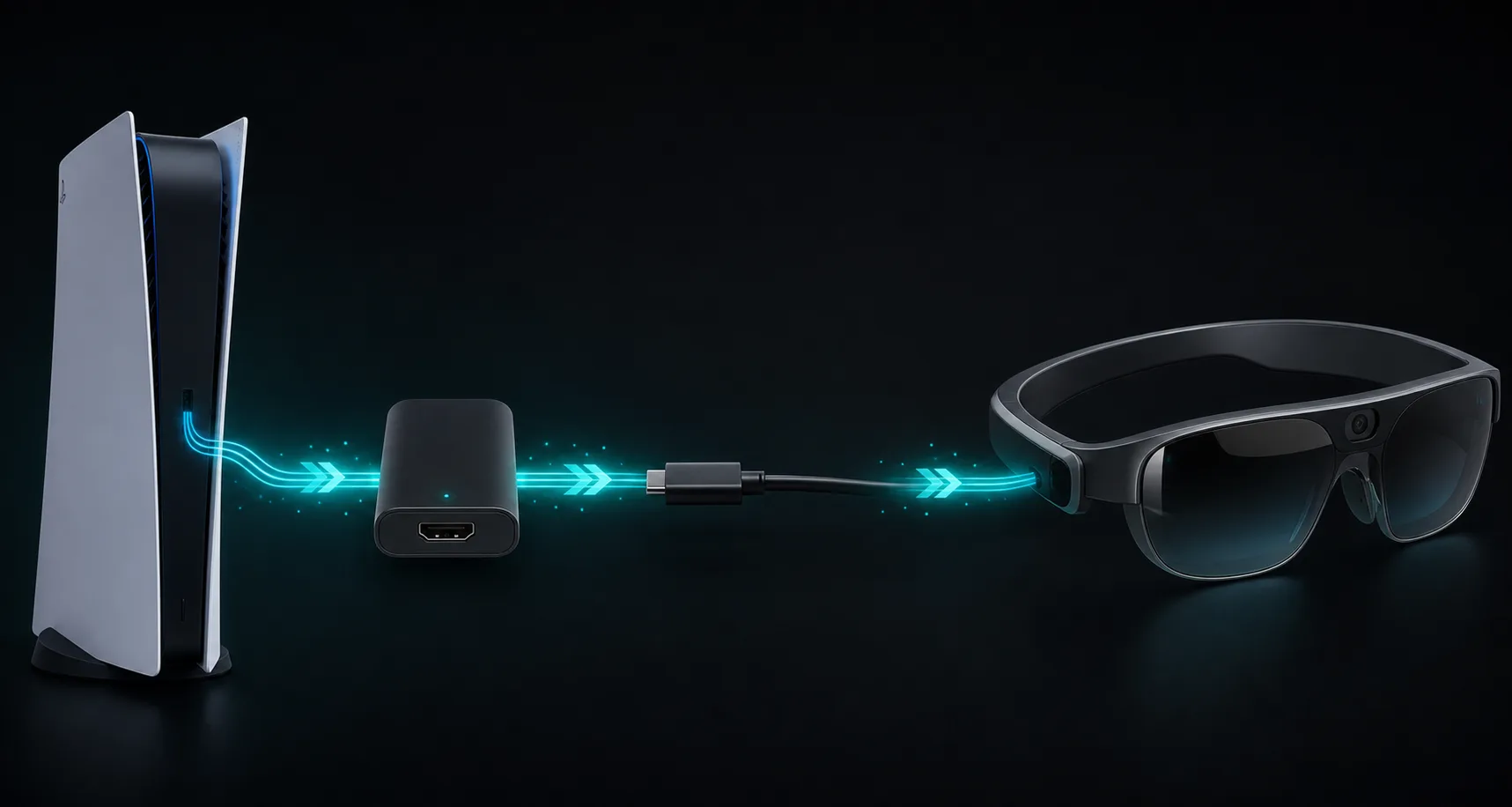
Neither pair is standalone, and neither negotiates: both need a USB-C port carrying DisplayPort Alt Mode video. That means direct, single-cable operation with modern MacBooks and Windows laptops, Steam Deck, PC handhelds, and DP-capable Android phones — and adapters or hubs for everything else. The device decides, not the glasses: the same cable story applies to both pairs. MFR SPEC
- PS5 / Xbox: console USB-C ports carry no video, so both need an HDMI-to-USB-C adapter with power in the chain — see the console guide and the adapters explainer.
- iPhone: USB-C iPhones can drive displays, but the adapter-versus-hub decision changes with your flight length — the iPhone guide walks it.
- Switch 2: needs a powered hub that triggers TV mode; XREAL’s NEO (~$99) is the common answer for both pairs — details in the Switch 2 guide.
- Steam Deck and PC handhelds: the cleanest case — direct, single cable, on both pairs — per the Steam Deck guide and handheld PC guide.
- MacBook: also direct and single-cable on recent USB-C models — full notes here.
One consequence worth planning around: with no battery in either frame, the source device drains while it drives. For long sessions on handhelds or consoles, a powered hub with passthrough is not an accessory — it is the difference between a two-hour session and a five-hour one. OUR ANALYSIS
06Prescriptions: dials versus inserts
This is the axis most comparisons skip and the one that decides daily comfort. The Max 2’s dials cover 0 to −6.00 D per eye, adjusted independently, with no lab, no waiting, and no extra cost — but they correct myopia only, so astigmatic users still need inserts and prescriptions beyond −6.00 D exceed the dials’ range. The mechanics and trade-offs are in our diopter adjustment guide. MFR SPEC
The One takes the inserts route for everyone: XREAL’s official prescription frame runs roughly $50–60 plus lens costs, and third-party labs (VR Rock, Frame of Choice, Lensology) cut inserts to your full prescription — including the astigmatism the Max 2’s dials cannot touch. One practical note in the One’s favor: its frame fits over many eyeglasses for quick tests, though inserts remain the clean solution. Both paths are laid out in our inserts guide, with the astigmatism specifics in this one.MFR SPEC
On fit: neither model publishes an IPD range or offers frame sizing — both are one fixed size. Birdbath-class optics are forgiving near the middle of the distribution and less so at its edges, so if you know your IPD sits unusually wide or narrow, buy from a retailer with a return window and test immediately. The IPD guide explains the measurement in under a minute. OUR ANALYSIS
07The verdict, by buyer

| If you are… | Buy | Why |
|---|---|---|
| Nearsighted, 0 to −6.00 D, no astigmatism | Max 2 — $279 store sale (list $429) | Dials replace inserts entirely; street pricing often undercuts the One. |
| Astigmatism in your prescription | One — $399 | Inserts can be cut to a full script; the Max 2’s dials cannot touch cylinder. |
| Steam Deck or laptop user who wants anchoring included | One — $399 | X1 chip anchors on-glasses; the Max 2 wants a $239 hub for the same behavior. |
| Long-session wearer prioritizing nose comfort | Max 2 — 75 g approx. | Nine grams less than the One’s 84 g — modest, real, and in your favor. |
| Virtual multi-monitor workspace builder | Max 2 + Station 2 | The only path in this pairing to 3DoF multi-screen layouts; budget ~$239 extra. |
XREAL One
DisplayThe safe default: sharp 50° display with spatial smarts built into the glasses.
$399approx.
List $499, price cut to $399 in Dec 2025
Pairs well with
- → 10Gbps rated USB-C cable — the included one is short; $12–18
- → Powered DP hub — for Switch 2 / handhelds; $60–100
- → Hard-shell case — the panels don't forgive pockets; $15–25
Accessory links may earn us a commission — same price either way. Prices approx.
Retailer links may earn us a commission — see our affiliate disclosure. Price approx., check retailer for current.
Rokid Max 2
DisplayDisplay glasses with −6.00 D diopter dials — strongest built-in vision correction.
$279approx.
Sale $279 at Rokid store (Sep 2026); regular $429 — check current price
Pairs well with
- → 10Gbps rated USB-C cable — the included one is short; $12–18
- → Powered DP hub — for Switch 2 / handhelds; $60–100
- → Hard-shell case — the panels don't forgive pockets; $15–25
Accessory links may earn us a commission — same price either way. Prices approx.
Retailer links may earn us a commission — see our affiliate disclosure. Price approx., check retailer for current.
Decoded verdict
One for most buyers; Max 2 for corrected eyes and lighter noses
Based on published specifications, owner reports, and stated criteria — we have not worn either pair for this comparison — the XREAL One ($399) is the safer default for most US buyers: spatial anchoring included rather than sold separately, a firmly specified 50° FOV and 600 nits, a real price cut already banked, and the category’s largest support network. It is why it leads our display glasses ranking, and its sibling comparison lives at One vs One Pro.
The Rokid Max 2 wins a specific and sizeable buyer: if your myopia falls inside 0 to −6.00 D, its dials delete the insert tax entirely; at the $378–399 street price it has frequently cost less than the One; and with the Station 2 it unlocks multi-screen layouts nothing else in this pairing matches. Its costs are equally concrete: $239 for full spatial features, myopia-only correction, and a thinner western support network. Check current prices on both before deciding — a $30 swing flips the value math, and both brands have repriced within the last year.
Against the wider field: VITURE’s $299 Pro 2 carries 0 to −5.00 D dials and undercuts both — that fight lives in our XREAL vs VITURE comparison. For the XREAL buyer, our XREAL lineup guide and One accessories list cover the hubs, inserts, and cases either pick will eventually want.
Our pick #2
Rokid Max 2
$279approx.
Display glasses with −6.00 D diopter dials — strongest built-in vision correction.
Check price on AmazonRetailer links may earn us a commission — price approx., check retailer.