Ray-Ban Meta vs Meta Ray-Ban Display: one logo, two products
Meta sells two glasses that look like cousins and do different jobs. The Gen 2 Ray-Ban Meta is a camera-and-AI pair at $409; the Ray-Ban Display adds a real (small) screen and a neural wristband at $799. Here's the honest split — including who should buy neither.
On this page
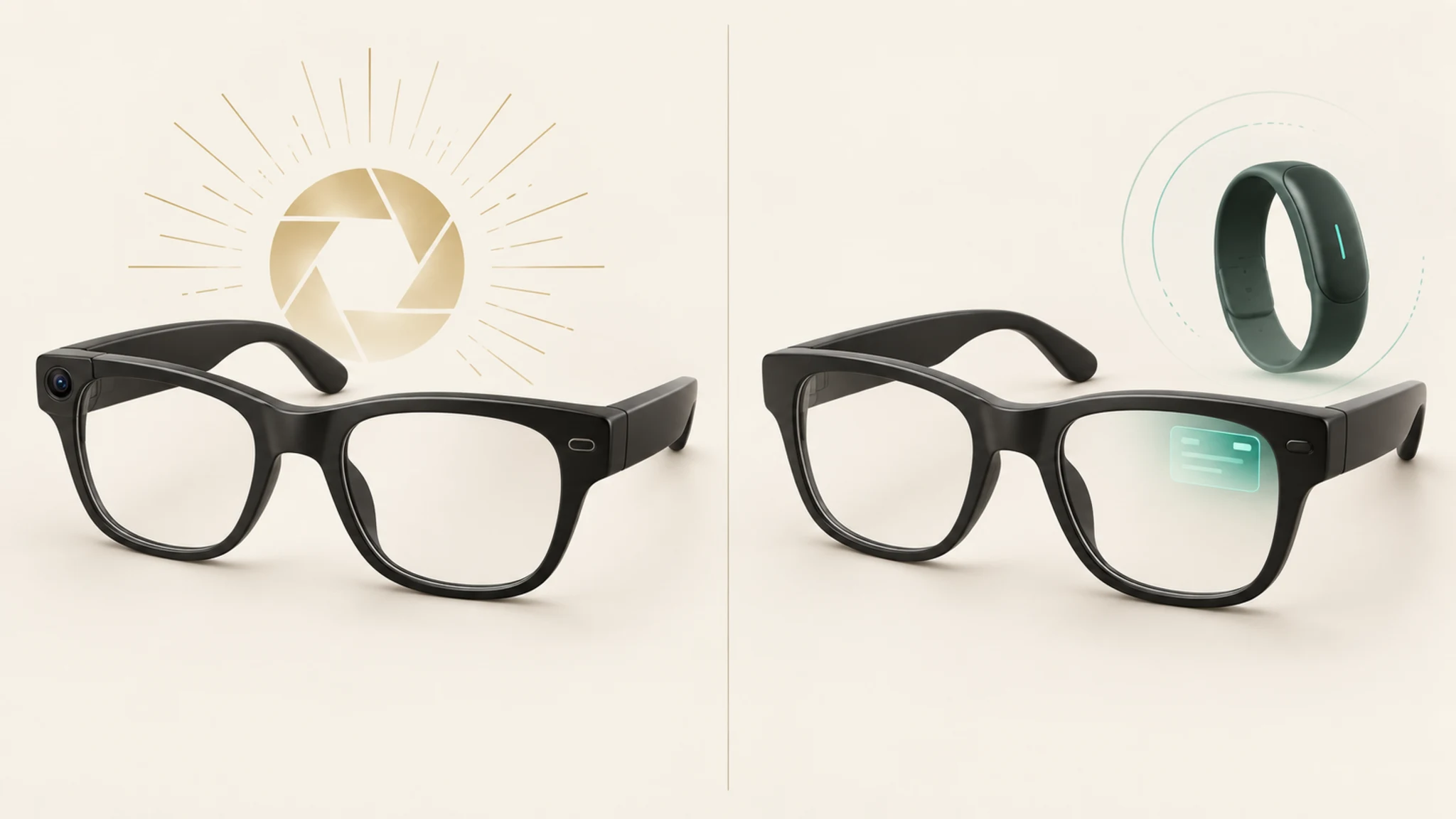
Meta's glasses lineup has a naming problem that trips up real buyers: the Ray-Ban Meta (Gen 2) — the camera glasses everyone means when they say "Ray-Ban Meta" — and the Meta Ray-Ban Display, a different product with a micro-LED screen and a neural wristband. They share frames and a charging philosophy. They do not share a job. This guide separates them, then tells you which buyer each one wins — including the large group of people who should buy neither.
The 30-second split
Want to capture and ask — photos, video, a voice assistant in your ear? That's the Gen 2 Ray-Ban Meta, $409. Want a screen floating in your vision for notifications, navigation, and live translation — and you'll wear the neural band? That's the Ray-Ban Display, $799. If you mainly want a big virtual monitor for a laptop or console, neither is it — that's tethered display glasses.
01The 30-second split
| Ray-Ban Meta (Gen 2)$409 | Meta Ray-Ban Display$799 | |
|---|---|---|
| Category | AI camera glasses | AI + monocular display |
| Camera | 12 MP ultra-wide, 3K video | 12 MP ultra-wide, 3K video |
| Display | None | Micro-LED waveguide, monocular, 600×600, 20° diagonal |
| Input | Voice, touch temple | Voice, touch, neural wristband (included) |
| Weight | ≈49 g | ≈50 g (glasses only) |
| Battery | Up to 8 h typical + ~40 h with case | Shorter with display in active use; case extends |
| Price | $409 (Wayfarer); premium styles to $459+ | $799 (neural band + Transitions included) |
Specs from Meta's published materials; both released Sep 2025. Retailer links below may earn us a commission — disclosure.
02Camera-first vs display-first
The Gen 2 Ray-Ban Meta doubles down on being excellent normal glasses with a camera: the biggest battery improvement in the line, 3K video, open-ear audio, and the widest style range in the category — that style range is a genuine feature, because glasses you won't wear are worthless. Its assistant answers in your ear; there is nothing to look at. MFR SPEC
The Ray-Ban Display answers a different question: can a screen live in normal-looking frames? Meta's answer is a small monocular micro-LED view — 600×600 on a single eye, roughly 14° horizontal — fed by the included neural wristband for subtle input. It keeps the camera. It is genuinely the most complete single device on the market; it is also a $799 first-generation take on an interface that Meta itself describes as early. MFR SPEC
The trap in the middle: buyers who want a "big screen" experience and buy the Display expecting a monitor. A 14° glance view is for notifications and glanceable info, not media or work. For screens that fill your vision, the answer is the tethered category — our category guide sorts this permanently.
Our pick
Ray-Ban Meta (Gen 2)
$409approx.
The default AI camera glasses: better battery, 3K video, huge style range.
Check price on AmazonRetailer links may earn us a commission — price approx., check retailer.
03What the Display's screen is actually like
The honest framing: the Display's view is a glanceable panel, closer to a car HUD than a monitor. Meta's own materials position it for notifications, navigation cues, live translation captions, and quick AI answers — moments where looking slightly up beats pulling out a phone. Reviewers who spent real time with it in 2026 converged on the same note: the hardware is impressive for its size, the software is early, and the value depends almost entirely on whether the neural-band input style clicks for you. REVIEWS
What it is not: a private cinema, a workstation, or a gaming screen. Those jobs need 50°+ binocular displays — the display-glasses guide covers that entire category, starting at $299.
Our pick
Ray-Ban Meta (Gen 2)
$409approx.
The default AI camera glasses: better battery, 3K video, huge style range.
Check price on AmazonRetailer links may earn us a commission — price approx., check retailer.
04The verdict, by buyer
Buy the Gen 2 Ray-Ban Meta if…
- → You want the most wearable, most normal-looking smart glasses made
- → Camera + assistant in your ear covers your use case
- → $409 fits; $799 doesn't
Retailer link; commission disclosed, price approx.
Buy the Ray-Ban Display if…
- → You want the glanceable-screen future and accept v1 software
- → The neural wristband input appeals rather than annoyances you
- → You kept the camera desire too — it's included
Retailer link; commission disclosed, price approx.
Decoded verdict
Most buyers: Gen 2 today. Enthusiasts who want the screen: Display. Screen-first buyers: neither.
The Gen 2 wins on wearability, battery, price, and refinement — it is the safe default in AI camera glasses, full stop. The Display is the more ambitious device and the more complete one, but you are paying $390 more for a first-generation interface whose input method is love-it-or-meh. And if what you actually want is a screen you can work on, skip both: that's tethered display glasses, a different aisle entirely.
Frequently asked questions
Is the Meta Ray-Ban Display the same as Ray-Ban Meta glasses?
Can the Ray-Ban Display show movies or work as a monitor?
Do both use the neural wristband?
Our pick #2
Meta Ray-Ban Display
$799approx.
A real display, a real camera, and a neural wristband — the most complete single device.
Check price on AmazonRetailer links may earn us a commission — price approx., check retailer.